
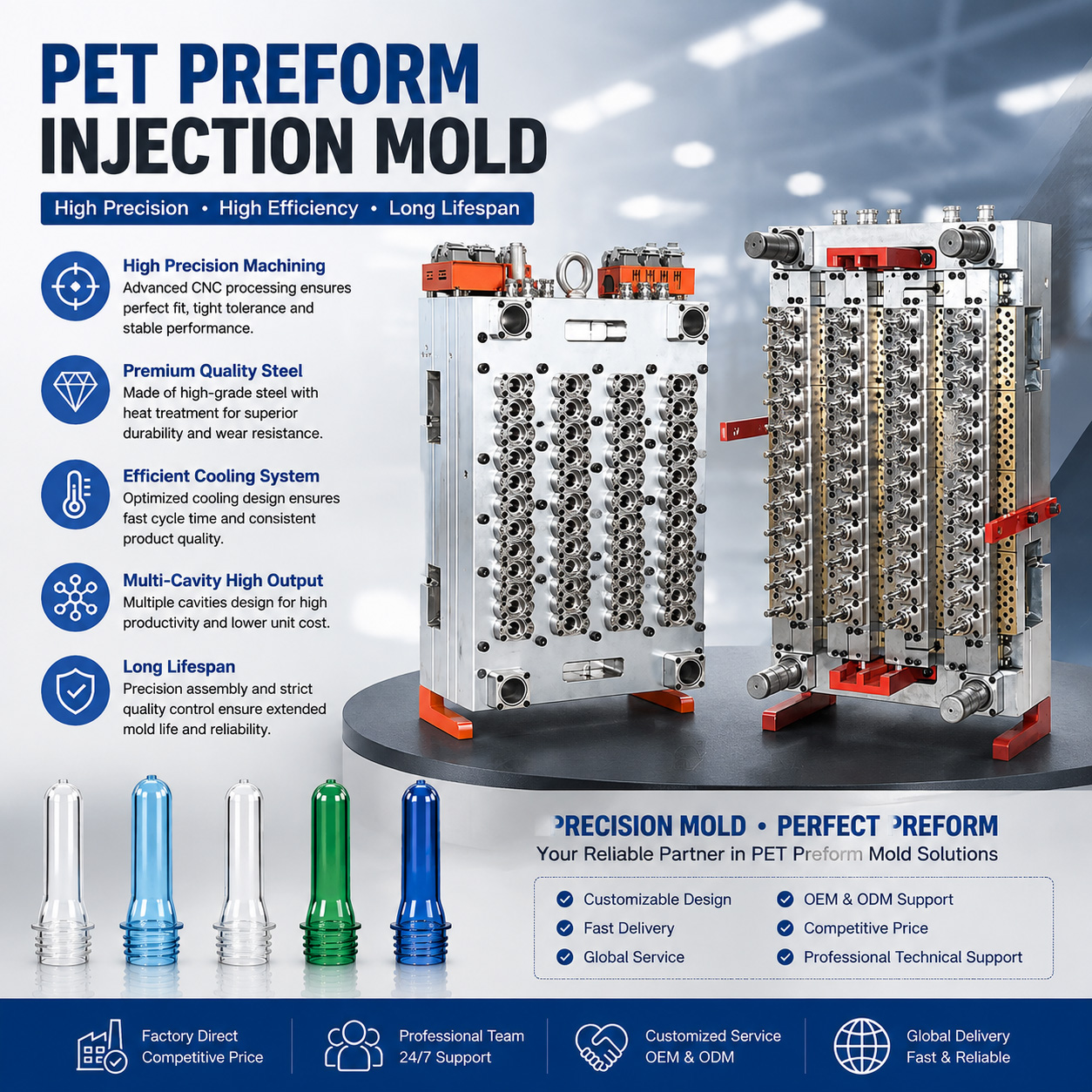
In high-volume PET bottle production, selecting the optimal mold cavity configuration is one of the most critical capital expenditure decisions a manufacturer can make. The balance between initial tooling investment, injection molding machine capacity, cycle time, and long-term unit economics dictates overall plant profitability. At ApexMolds, as a specialized manufacturer of high-precision PET preform molds, we frequently assist global packaging leaders in navigating this strategic choice.
This technical analysis evaluates three industry-standard configurations—48, 72, and 96 cavity preform molds—across output efficiency, cost per preform, machine requirements, and Return on Investment (ROI).
1. Overview of Cavity Configurations
48-Cavity Preform Molds: Flexibility and Mid-Scale Versatility
The 48-cavity mold is typically deployed on medium-tonnage injection molding machines (ranging from 200T to 300T depending on preform weight and neck finish). It offers high operational flexibility, making it ideal for facilities handling frequent mold changeovers, specialized custom bottle shapes, or moderate production volumes.
72-Cavity Preform Molds: The Balanced Sweet Spot
The 72-cavity layout represents an optimal compromise for medium-to-high volume beverage and edible oil producers. It leverages wider machine clamp availability while delivering a substantial boost in hourly output compared to 48-cavity systems, without demanding the extreme precision alignment required by ultra-high cavity setups.
96-Cavity Preform Molds: Maximum Scale and Lowest Unit Cost
Engineered for massive industrial scale, 96-cavity molds are designed for dedicated, continuous long-run production of standard preforms (e.g., CSD, water, or juice bottles). Operating on high-tonnage specialized PET injection machines (usually 350T to 450T+), they achieve the lowest possible cost per preform.
2. Comparative Technical Metrics
| Performance Metric | 48 Cavity Mold | 72 Cavity Mold | 96 Cavity Mold |
|---|---|---|---|
| Typical Cycle Time | 10.5 - 13.0 s | 11.0 - 14.0 s | 12.0 - 15.0 s |
| Hourly Output (Est. 20g preform) | ~13,300 - 16,400 pcs/hr | ~18,500 - 23,500 pcs/hr | ~23,000 - 28,800 pcs/hr |
| Required Machine Tonnage | 200T – 250T | 250T – 350T | 350T – 450T+ |
| Initial Tooling Investment | Low - Moderate | Moderate - High | High |
| Cost Per Preform | Highest of the three | Competitive / Mid-tier | Lowest at scale |
| Changeover Flexibility | High | Moderate | Low (Dedicated setup) |
3. Key Evaluation Criteria for Decision-Makers
Output Volume vs. Market Demand
If your annual requirement stays below 50 million preforms with diverse SKU switching, a 48-cavity mold prevents machine underutilization. However, for mega-plants producing 150+ million units annually, a 96-cavity mold is essential to meet delivery SLAs and minimize machine operating hours.
Hot Runner Balance and Temperature Control
As cavity count increases from 48 to 96, thermal management becomes exponentially complex. Uneven temperature distribution across a 96-cavity hot runner system leads to wall thickness variations and concentricity defects. ApexMolds utilizes advanced CFD thermal simulation and superior German/Swedish mold steels (such as 1.2316 or S136) to ensure strict gate balance and minimal weight tolerance ($\pm 0.3\%$) across all 96 cavities.
Total Cost of Ownership (TCO) and ROI
While a 96-cavity mold commands a higher upfront investment, its labor and energy cost allocation per unit drops significantly. The ROI timeline depends heavily on machine uptime. A well-maintained 72 or 96 cavity mold from ApexMolds typically achieves full ROI within 12 to 18 months under 24/7 continuous operation.
ApexMolds Engineering Recommendation
Choose 48 cavities if you prioritize product line diversification and lower initial CapEx. Choose 72 cavities for balanced high-efficiency mid-market operations. Choose 96 cavities if you run high-volume, standardized bottle lines where minimized cost-per-part dictates market competitiveness.
Conclusion
Selecting between 48, 72, and 96 cavity preform molds requires a holistic evaluation of your injection machine specifications, volume projections, and quality tolerances. As your trusted partner in mold engineering, ApexMolds provides custom-tailored simulation, precision manufacturing, and complete turnkey preform solutions designed to maximize your production throughput.