
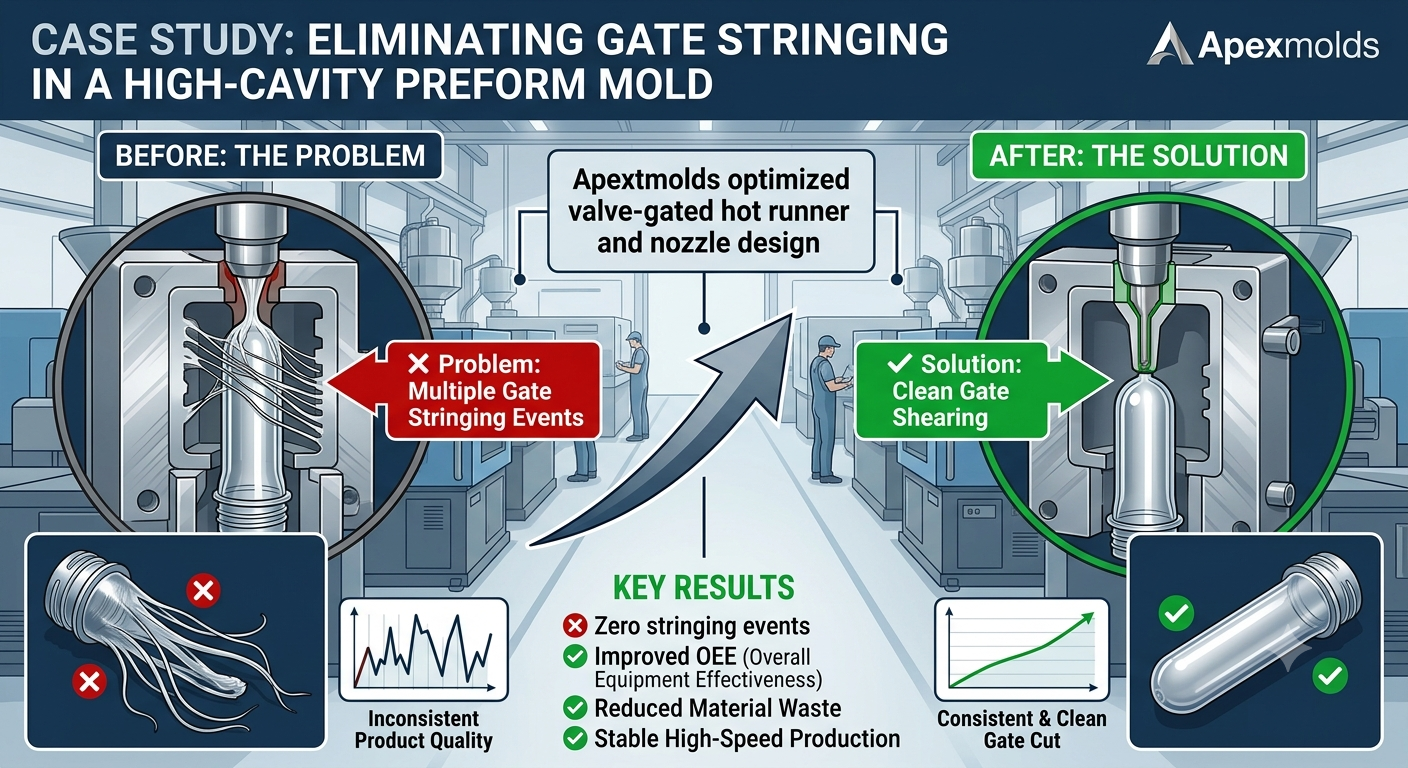
Case Study: Eliminating Gate Stringing in a High-Cavity Preform Mold
Executive Summary
In high-cavity PET preform injection molding, production consistency is highly dependent on clean gates. A multinational packaging client operating a 72-cavity water preform line integrated with a high-speed blowing system faced severe operational disruption due to **gate stringing** (drooling or vestige pulling). The thread-like plastic residues left at the injection point accumulated on the mold face, causing automatic cycle interruptions, damage to the core components, and a **14% drop in overall equipment effectiveness (OEE)**.
By executing an engineering overhaul focusing on balanced rheology, precise thermal isolation, and mechanical valve-gate synchronization, Apexmolds completely eliminated gate stringing. This case study details the technical diagnostics and customized tooling engineering that restored the client’s production line to zero-defect performance.
1. The Technical Challenge: What Triggers Gate Stringing?
Gate stringing occurs when the molten PET resin inside the hot runner nozzle tip does not solidify or separate cleanly from the molded preform during mold opening. As the mold halves retract, the still-molten polymer stretches into fine, hair-like threads.
Through comprehensive diagnostic review, the Apexmolds technical team identified three root system failures in the client’s legacy high-cavity mold:
- Thermal Overshoot at the Nozzle Tip: Imbalanced PID temperature control loops caused localized overheating at the nozzle tips. The excessive heat prevented the PET resin at the gate from reaching its crystallization or freezing point before ejection.
- Delayed Valve Pin Closure: In high-cavity configurations (48-cavity and above), pneumatic pressure drops across long air circuits can cause asynchronous valve pin actuation. A delay of even 0.1 seconds allows pressurized melt to droop out after cavity filling.
- Degraded Gate Insert Geometry: Continuous high-pressure cycling had physically eroded the sharp land area of the gate inserts, altering the mechanical shear required to shear the plastic cleanly.
2. The Apexmolds Engineering Solution
As dedicated professional PET preform mold solution experts, Apexmolds applied a three-pronged technical optimization plan to the tooling infrastructure:
A. Implementation of Apex-Flow Balanced Valve-Gated Hot Runner
We replaced the legacy manifold with our proprietary **Apex-Flow hot runner system**. Each nozzle features an independent, pneumatic piston assembly that ensures instantaneous, synchronized valve pin closure across all 72 cavities. The system utilizes double-guided valve pins manufactured from high-speed tool steel with a low-friction coating, keeping mechanical concentricity tight and preventing any lateral deflection.
B. Advanced Thermal Isolation & Copper Alloy Tips
To establish absolute thermal separation between the hot runner nozzle (maintaining a melt temperature around 285°C) and the water-cooled cavity plate (maintained at 8°C to 12°C), Apexmolds engineered custom nozzle tips using a **high-conductivity copper alloy** paired with a ceramic insulating seal ring. This precise layout permits rapid heat removal right at the gate land during the cooling phase, forcing the PET at the tip to freeze instantly upon valve closure, cutting off any chance of drooling.
C. Finite Element Analysis (FEA) Guided Melt Control
Using Moldflow and thermodynamic FEA simulations, we redesigned the internal flow channels to minimize pressure drops and prevent localized shear heating. This balanced the viscosity of the PET resin entering all 72 cavities, guaranteeing identical shot weights and uniform thermal profiles across the entire mold face.
3. Performance Results & ROI Metrics
Following the installation of the optimized Apexmolds high-cavity system, the plant monitored performance metrics over a 30-day continuous production cycle:
| Operational Parameter | Legacy 72-Cavity Tooling | Optimized Apexmolds Tooling | Net Technical Gain |
|---|---|---|---|
| Gate Stringing Incidents | Average 42 stops per 24 hours | 0 stops | 100% Elimination |
| Overall Equipment Effectiveness (OEE) | 78.5% | 93.2% | + 14.7% OEE Increase |
| Gate Vestige Height Accuracy | Variable (≤ 1.2 mm with stringing) | Consistent ≤ 0.2 mm (Flush gate) | Premium Surface Quality |
| Mold Maintenance Interval | Every 150,000 cycles (Face cleaning) | Every 2,000,000 cycles (Standard PM) | Reduced Labor Downtime |
Conclusion: Trust the PET Preform Solution Experts
High-cavity injection molding leaves no margin for error. A minor issue like gate stringing can result in costly unscheduled downtime, compromised preform quality, and premature tooling wear. As demonstrated in this case study, resolving these defects demands an intimate understanding of thermodynamics, mechanical synchronization, and rheology.
Apexmolds combines advanced engineering software, premium tool steels, and proprietary hot runner designs to manufacture molds that operate seamlessly at peak efficiency. Contact our technical engineering department today to audit your production lines and implement professional solutions optimized for long-term profitability.