
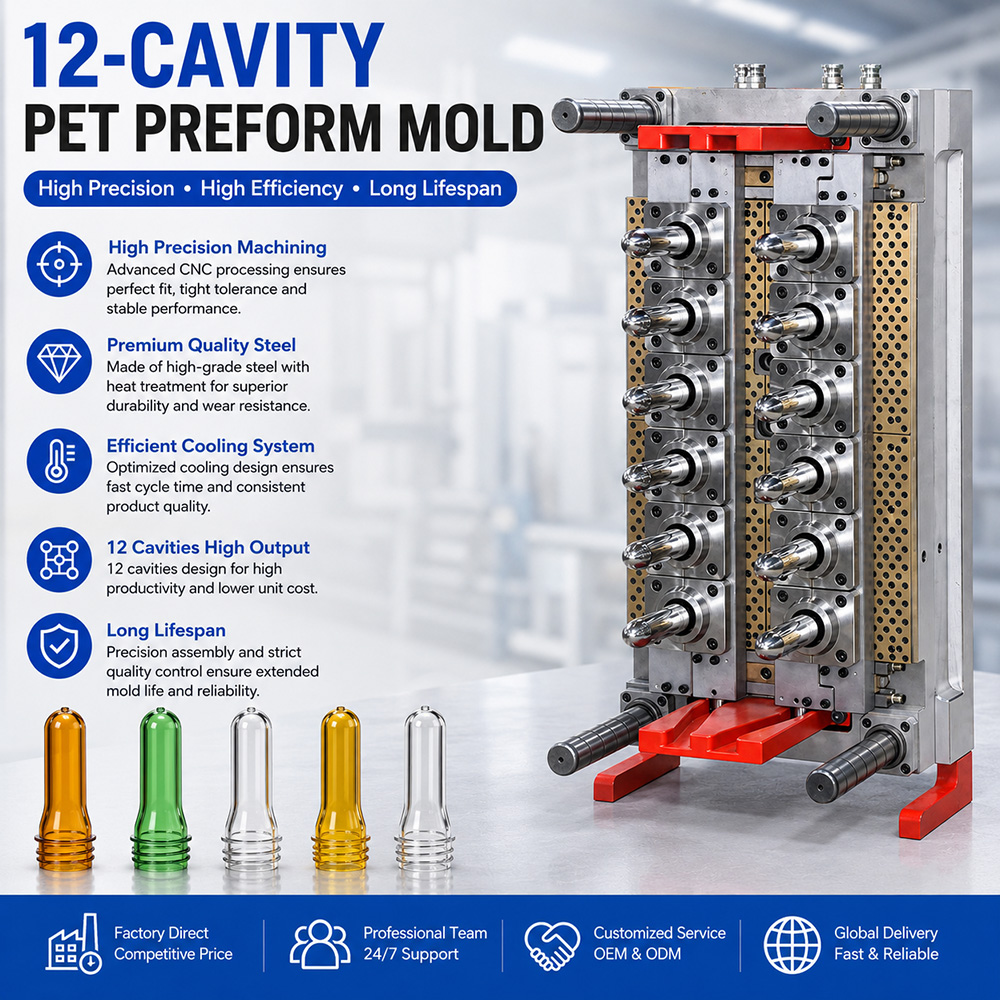
Case Study: Running 100% rPET in a High-Cavity Preform Mold – What It Takes
Transitioning from virgin Polyethylene Terephthalate (PET) to 100% Recycled PET (rPET / PCR) represents one of the most critical sustainability milestones for global beverage packaging manufacturers. However, converting high-cavity preform tooling—such as 48-cavity, 72-cavity, or 96-cavity platforms—to process 100% post-consumer recycled flakes is notoriously challenging. Fluctuating Intrinsic Viscosity (IV), residual volatile outgassing, and abrasive micro-contaminants often result in yellowing, gate tailing, burn marks, and rapid mold wear.
When a leading European contract beverage packaging group needed to transition a high-volume 72-cavity water bottle line to 100% food-grade rPET, they partnered with ApexMolds. Through specialized hot runner modification, advanced core/cavity metallurgical coatings, and optimized micro-venting architecture, ApexMolds achieved continuous, zero-defect production at virgin-grade cycle speeds. This technical case study analyzes the engineering interventions required to make 100% rPET molding commercially viable at scale.
1. The Challenge: Processing Instability with 100% PCR Feedstock
Prior to upgrading their tooling with ApexMolds, the client attempted to run a 100% rPET blend on conventional 72-cavity preform molds. The trial resulted in severe operational bottlenecks:
Key Failure Modes Encountered:
- Severe IV Degradation & Thermal Yellowing: High shear stress in standard narrow hot runner channels reduced resin Intrinsic Viscosity by over 0.08 dL/g, weakening bottle top-load capacity and creating an unappealing yellow tint.
- Gas Entrapment & Burn Marks: Volatiles and residual organic moisture trapped in recycled PCR flakes clogged traditional parting-line vents within 12 hours of operation, causing localized burn marks and short shots.
- Gate Abrasive Wear & Crystallization: Hard inorganic micro-particles present in PCR flakes caused accelerated erosion on standard valve pins and nozzle tips, leading to uneven gate stems and leaking.
2. The ApexMolds Engineering Solution: Specialized rPET Tooling Retrofit
To eliminate process instability, ApexMolds engineered a customized, high-density 72-cavity preform mold platform built specifically for high-percentage PCR and 100% rPET applications.
| Engineering Aspect | Legacy Standard Mold Setup | ApexMolds 100% rPET Engineered Platform | Performance & Quality Benefit |
|---|---|---|---|
| Hot Runner Geometry | High-shear, small-bore flow paths | Generous low-shear manifold channels with smooth turn radii | Minimal IV loss (< 0.02 dL/g) & preserved preform clarity |
| Gas Venting Architecture | Standard static parting line vents (0.015mm) | Self-cleaning vacuum-assisted micro-venting channels | Zero burn marks; extended continuous run cycles without cleaning |
| Surface Hardening Coating | Uncoated tool steel inserts | Titanium Carbonitride (TiCN) & DLC coated core/cavity stacks | Superior abrasion resistance against PCR contaminants (>5M cycles) |
| Thermal Management | Standard series cooling circuits | Conformal, high-velocity cooling surrounding gate & neck finishes | Eliminates neck warping & maintains 9.8s ultra-fast cycle times |
| Scrap & Reject Rate | 4.5% due to yellowing & burn defects | < 0.3% consistent quality yield | 93.3% defect rate reduction |
Key Hardware Innovations Implemented:
- Low-Shear Pneumatic Valve Gate System: ApexMolds integrated multi-zone pneumatic valve-gate actuators with custom-tapered shut-off pins. This design reduces local shear rates during injection, preventing thermal breakdown while ensuring a completely flush (<0.1mm) gate nub.
- Swedish S136 Stainless Steel Stacks with PVD Protection: All cores, cavities, and neck rings were machined from premium Swedish S136 stainless steel (HRC 48-52) and treated with Physical Vapor Deposition (PVD) coatings to withstand abrasive wear from recycled flake particles.
- Dynamic Temperature Zoning: Closed-loop PID controllers provided individual tip temperature adjustments within ±0.5°C across all 72 nozzles, compensating for batch-to-batch rPET viscosity shifts.
3. Case Results: Commercial Success and Long-Term ROI
Following full installation and validation by the ApexMolds technical team, the client successfully transitioned to 100% rPET continuous manufacturing:
- Continuous 100% rPET Production: Successfully maintained 100% food-grade PCR processing with preform clarity and top-load performance matching virgin PET standards.
- Maintenance Interval Extended by 400%: Self-cleaning micro-venting reduced mold maintenance stops from twice weekly to once every six weeks, dramatically increasing total operational uptime.
- Rapid ROI Achievement: By replacing 100% virgin resin with post-consumer recycled flakes while maintaining fast 9.8-second cycle times, the client recouped their entire tooling investment within 11 months.
Conclusion: Partnering with ApexMolds for Circular Economy Tooling
Successfully running 100% rPET in a high-cavity preform mold is not merely a material swap—it requires a fundamentally re-engineered hot runner system, specialized metallurgy, and aggressive thermal management. ApexMolds provides high-precision, turn-key rPET preform molds that empower converters to meet aggressive sustainability targets while driving maximum profitability.
Planning to upgrade your preform tooling for 100% rPET or PCR blends? Contact the technical engineering specialists at ApexMolds today for custom quotes and feasibility analysis.