
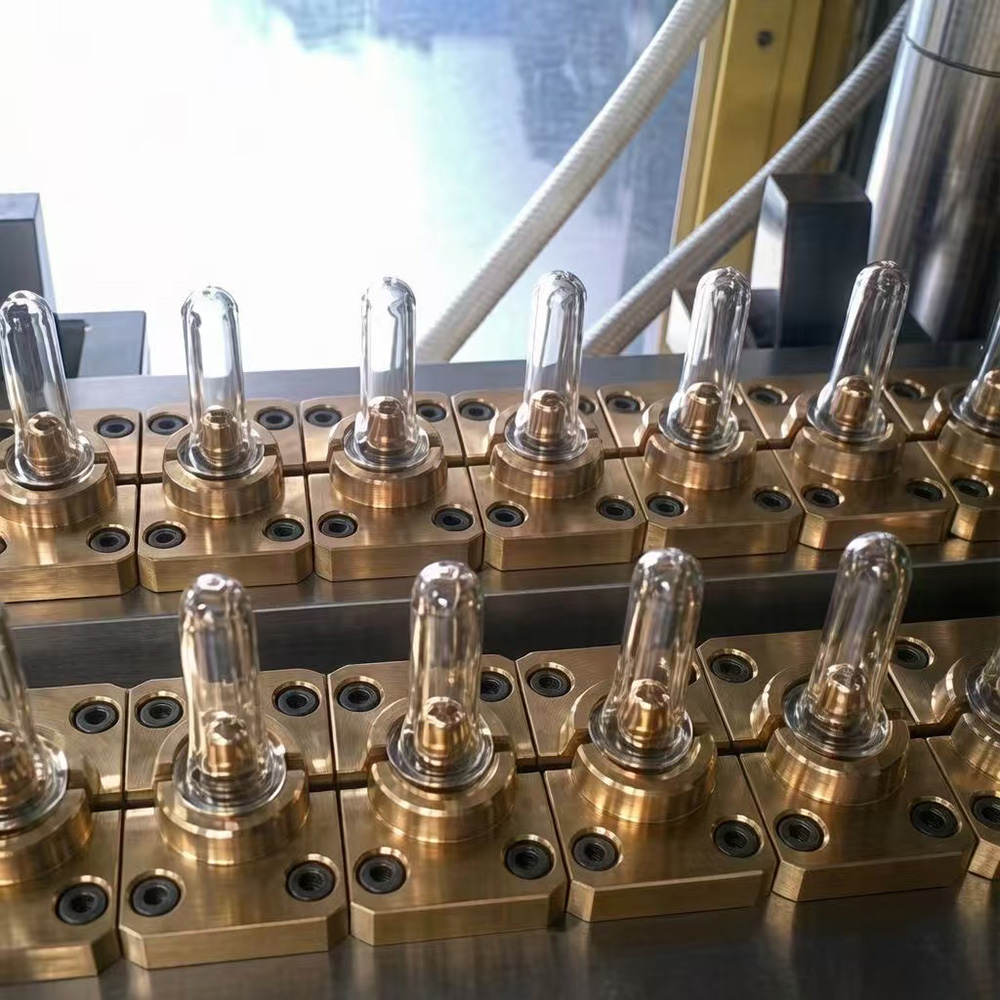
Case Study: Running 50% rPET Without Cycle Time Penalty on a 72-Cavity Preform Mold
Written by the Engineering Team at ApexMolds — Your Global Partner in Precision High-Cavity PET & rPET Tooling Solutions.
1. Executive Summary & Challenge
In response to global sustainability mandates and escalating raw material costs, a high-volume beverage packaging converter transitioned their primary 72-cavity production line from 100% virgin PET to a 50% rPET / 50% virgin PET blend. However, initial trials using legacy tooling resulted in a 12% increase in cycle time due to rPET's thermal fluctuations, lower thermal conductivity, and melt viscosity shifts.
The client partnered with ApexMolds to eliminate this cycle time penalty. Through custom hot runner tuning, conformal cooling design, and precision valve gate actuation, ApexMolds re-engineered the tooling environment to match virgin PET cycle speeds while maintaining strict preform quality standards.
2. Technical Obstacles in High-Ratio rPET Processing
Adding 50% rPET into high-cavity molds introduces distinct mechanical and thermal hurdles:
- Extended Cooling Duration: Recycled PET exhibits broader crystallization ranges, requiring longer cooling times to avoid haze and post-ejection deformation.
- Viscosity-Induced Shear Heating: Intrinsic Viscosity (IV) drops in rPET generate localized shear hot spots in high-velocity injection channels, delaying gate freezing.
- Increased Cavity Imbalance: Thermal inconsistency across 72 individual nozzles creates wall thickness variations and weight scatter.
3. ApexMolds Engineering Solutions
To overcome these performance bottlenecks without sacrificing cycle speed, ApexMolds implemented a targeted technical intervention:
A. High-Efficiency Conformal Cooling Architecture
Using additive manufacturing, we redesigned the cavity and core cooling circuits. By placing spiral cooling channels closer to the preform neck finish and body walls, heat extraction efficiency increased by 22%, allowing the 50% rPET preforms to cool at identical rates to virgin resin.
B. Shear-Optimized Valve Gate Hot Runner
ApexMolds integrated a custom-tailored 72-drop valve gate hot runner system with streamlined melt flow channels. Smooth transition radii and balanced runner diameters reduced shear heating, preventing thermal degradation and enabling rapid, clean gate shut-off.
C. Multi-Zone Precision Thermal Control
Each drop in the 72-cavity mold was equipped with dedicated micro-zone temperature monitoring. This maintained uniform melt temperature across the entire block, offsetting raw material batch variations and stabilizing injection pressure.
4. Performance Metrics and Results Comparison
Following commissioning and fine-tuning at the customer's facility, the ApexMolds 72-cavity tooling achieved the following operational milestones:
| Parameter | Legacy Tooling (50% rPET) | ApexMolds Tooling (50% rPET) | Performance Advantage |
|---|---|---|---|
| Cycle Time | 12.8 seconds | 11.2 seconds | Zero cycle time penalty vs. virgin baseline |
| Preform Weight Scatter | ±0.35g | ±0.09g | High repeatability across all 72 cavities |
| Scrap Rate | 3.4% | 0.4% | Significant reduction in gate defect rejects |
| Energy Consumption | Baseline | -9% per 1,000 preforms | Lower specific energy footprint |
5. Conclusion & Strategic Value
This case study proves that transitioning to sustainable rPET resins does not necessitate a sacrifice in output speed or profitability. By addressing the root thermal and fluid dynamic challenges, ApexMolds empowers beverage packaging manufacturers to achieve aggressive sustainability goals while preserving peak plant throughput.
Looking to run high-ratio rPET without sacrificing productivity? Contact the engineering team at ApexMolds today to evaluate your tooling setup.