
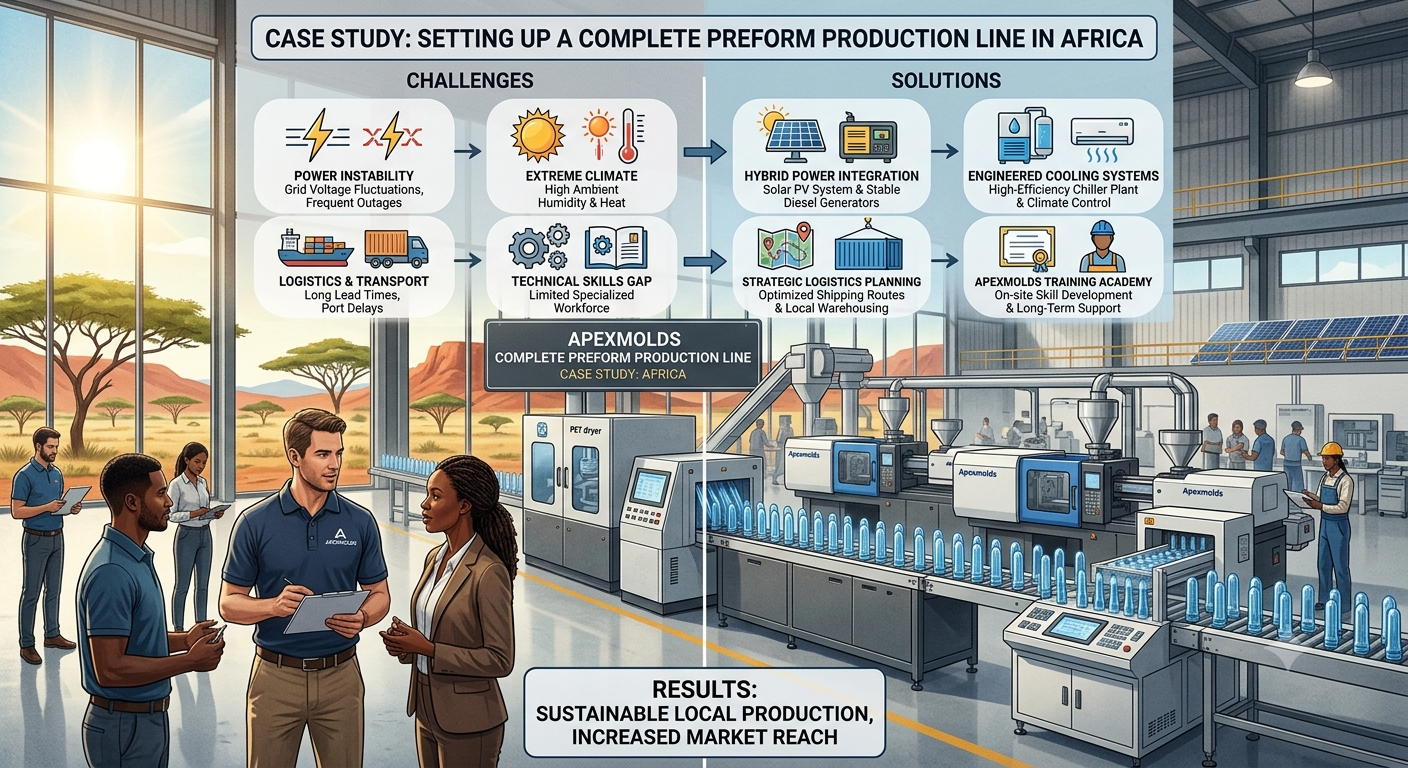
Case Study: Setting Up a Complete Preform Production Line in Africa——Challenges & Solutions
The rapid expansion of the food, beverage, and bottled water sectors across African nations has created an unprecedented demand for localized packaging production. Converting raw PET resin into high-grade preforms locally dramatically reduces transportation logistics costs, shortens lead times, and elevates supply chain autonomy. However, establishing an operational, highly efficient, and profitable PET preform injection line in Africa presents unique engineering and environmental hurdles.
As a leading PET preform mold manufacturer and turnkey engineering expert, Apexmolds recently engineered, commissioned, and optimized a 32-cavity high-speed PET preform production line for a premier beverage manufacturer in Sub-Saharan Africa. This technical case study details the field challenges encountered during project implementation and demonstrates how tailored mold engineering and system-level optimization yielded a seamless, robust, and cost-effective operation.
Executive Summary: Apexmolds delivered an end-to-end 32-cavity valve-gate preform molding solution capable of producing 18.5g PCO 1881 water preforms at a continuous cycle time under 10.8 seconds, achieving a 99.4% yield rate despite extreme ambient humidity and ambient temperatures exceeding 42°C.
1. Project Background & Baseline Objectives
The client required an in-house preform manufacturing platform to supply their automated stretch blow molding (SBM) bottled water lines. Key target specifications included:
- Application: Mineral water bottle preforms (330ml & 500ml).
- Preform Weight & Neck Finish: 18.5g with standard PCO 1881 neck profile.
- Target Output: Over 10,000 preforms per hour.
- Operational Conditions: Unstable power supply grids, elevated ambient workshop temperatures (38°C–45°C), and high seasonal relative humidity (up to 85%).
2. Technical Challenges Encountered in the African Operating Environment
Challenge A: Thermal Management & Dew Point Condensation in High Ambient Heat
In hot and humid tropical climates, mold cooling is the primary bottleneck. Standard cooling channels often fail to maintain uniform heat dissipation across core and cavity components. Furthermore, operating mold temperatures below the ambient dew point results in moisture condensation on mold faces, causing water marks, AA (Acetaldehyde) spike, and surface defects on the preforms.
Challenge B: Grid Voltage Fluctuations & Thermal Instability
Power instability and voltage spikes lead to erratic heating within hot runner systems. Uncontrolled hot runner temperatures degrade PET resin, resulting in thermal stress, yellowing, gate crystallization, or material degradation within the hot runner manifold.
Challenge C: Preform Quality Issues (Crystallinity, AA Levels, & Eccentricity)
Maintaining optical clarity (low haze), strict wall thickness tolerance (eccentricity < 0.08mm), and low Acetaldehyde (AA) content for pristine drinking water flavor requires flawless mold alignment and precise melt distribution across all cavities.
Challenge D: Skill Gap & Local Maintenance Capabilities
Complicated mold maintenance routines can cause prolonged machine downtime in facilities lacking specialized tooling technicians. The system required a simplified modular design to ensure long-term, hassle-free operational stability.
3. Apexmolds Engineering Solutions & Implementation
| Field Challenge | Apexmolds Engineering Solution | Technical Outcome |
|---|---|---|
| Extreme Ambient Heat & Mold Condensation | 3D Conformal Cooling Channels + Enclosed Dehumidification Housing System | Optimized cycle time to 10.8s; eliminated condensation defects completely. |
| Thermal Degradation & Gate Drooling | Pneumatic Valve Gate Hot Runner with Individual Zone Temperature Control | Zero stringing, low AA generation, and perfect gate aesthetic. |
| Wall Thickness Variation / Eccentricity | Double-Taper Self-Locking Mold Structure & Premium S136 Stainless Steel | Eccentricity kept tightly within ≤0.05mm across all 32 cavities. |
| Frequent Wear & Maintenance Downtime | Interchangeable Cavity/Core Inserts with Titanium-Plated Components | In-line component replacement without taking the entire mold down. |
1) Advanced Cooling Channel Design (3D Conformal Cooling)
Apexmolds engineered the core and neck ring inserts using high-thermal-conductivity beryllium-copper alloys combined with deep-hole spiral cooling channels. By maximizing heat exchange near the gate area and neck finish, we achieved rapid solidification without thermal residual stress. Paired with a localized dry-air enclosure around the mold clamping area, condensation was completely prevented.
2) Precision Valve-Gate Hot Runner Technology
To withstand power fluctuations and prevent gate stringing or thermal degradation, Apexmolds integrated its proprietary pneumatic valve-gate hot runner system. Featuring German-made heating elements and PID multi-zone control, melt temperature uniformities within ±1°C were guaranteed. The mechanical shut-off pin guarantees a smooth, crystalline-free gate nub (height ≤ 0.2mm), protecting blow-molding needles from damage.
3) Structural Rigidity & Self-Locking Alignment
Using imported Swiss S136 anti-corrosive stainless steel hardened to HRC 48-52 for cavities, cores, and neck rings, Apexmolds applied a double-taper self-locking structural design. This structural mechanism prevents core shift during high-pressure injection, guaranteeing uniform wall thickness and eliminating downstream blowing burst rates.
4) Modular Maintenance Concept for Local Operators
Apexmolds designed all wear parts (neck rings, core tips, valve needles, and nozzle tips) to standard interchangeable dimensions. Local technicians can perform swift maintenance or swap cavity inserts directly on the injection molding machine without removing the main mold frame, reducing routine downtime by over 70%.
4. Results & Operational Performance
Following comprehensive installation, system calibration, and hands-on staff training conducted by Apexmolds field engineers on-site, the plant achieved full-scale commercial production within 5 days of commissioning:
- Continuous Cycle Time: Stable at 10.8 seconds (compared to industry average 12.5s in similar regional plants).
- Product Quality Compliance: 100% pass rate for optical clarity, zero stress whitening, and AA levels compliant with strict international beverage standards (<3.0 ppm).
- Production Yield: Sustained overall line efficiency exceeding 99.4%.
- Energy Efficiency: Reduced energy consumption per unit preform by 14% via optimized heating and quick-chilling mold dynamics.
5. Why Partner with Apexmolds as Your Preform Solution Expert?
Setting up a preform production line in challenging environment requires more than just machinery; it demands end-to-end engineering foresight. At Apexmolds, we specialize in high-precision PET preform molds (ranging from 8 to 144 cavities), cap molds, and comprehensive turnkey solution engineering tailored to regional climate and industrial infrastructure reality.
From initial preform weight design and CAD stress simulation to hot runner customization, auxiliary system integration, and on-site commissioning, Apexmolds empowers global beverage brands and packaging converters to achieve maximum ROI with minimal operational risk.
Planning to Build or Upgrade Your PET Preform Line?
Consult with Apexmolds engineering experts today for tailored mold designs, layout planning, and complete turnkey solution proposals.