
Global PET Preform Mold Market Outlook 2026–2032: Trends, Growth Drivers, and Regional Demand
As the global beverage, liquid packaging, personal care, and pharmaceutical sectors expand, the rigid plastic packaging industry is undergoing a structural transition. Looking ahead across the forecast horizon of 2026 to 2032, the global PET preform mold market is projected to experience strong compound growth. This trajectory is driven by continuous material lightweighting initiatives, strict government mandates for Recycled Polyethylene Terephthalate (rPET) integration, and the rapid adoption of high-density, fast-cycle injection molding systems.
At ApexMolds, we operate at the intersection of market demand and technical innovation. By combining high-precision machining, custom hot runner engineering, and thermal management technologies, ApexMolds equips global bottling operations and plastic converters to navigate evolving regional regulations and economic shifts. This market outlook provides an executive breakdown of the primary macro trends, key growth drivers, and regional dynamics shaping the PET tooling industry over the next six years.
1. Core Macro Trends and Technical Growth Drivers (2026–2032)
Analyzing global procurement patterns reveals three primary technology shifts accelerating capital expenditure (CAPEX) in modern PET preform tooling:
A. Mandatory Circularity and High-Percentage rPET Transition
Environmental packaging policies across the European Union, North America, and parts of Asia now require minimum post-consumer recycled (PCR) content thresholds of 25% to 50% in beverage containers. Processing rPET introduces viscosity fluctuations, volatile outgassing, and abrasive wear. Tooling manufacturers must deliver specialized low-shear hot runners and enhanced self-cleaning micro-venting architectures to prevent defects and preserve resin Intrinsic Viscosity (IV).
B. Migration to Ultra-High Cavitation & Fast Cycle Platforms
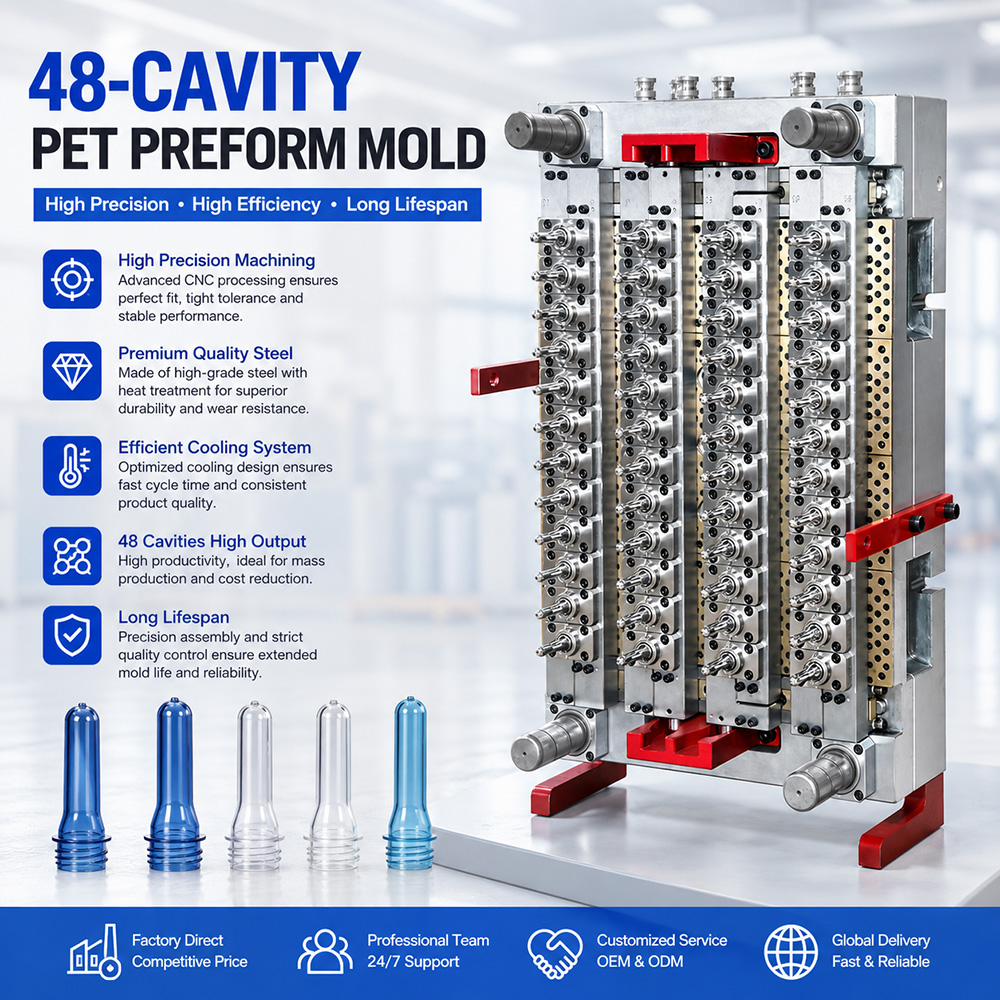
To offset rising resin, labor, and electricity costs, large-scale bottlers are replacing legacy 24-cavity and 48-cavity tools with 72-cavity and 96-cavity preform molds. Operating these ultra-dense tools requires extreme thermal control, core concentricity within ±0.03mm, and dynamic valve-gate balancing to maintain cycle times below 9.0 seconds.
C. Next-Generation Lightweighting & Tethered Cap Standards
Weight reduction remains the single largest operational cost-saver. Transitions toward neck finishes like PCO 1881, GME 30.37, and tethered cap configurations demand tight dimensional tolerances. Molds must prevent neck deformation while maintaining container top-load strength through optimized wall thickness distribution.
2. Regional Market Dynamics & Sourcing Analysis
Demand drivers for PET preform molds vary significantly across major geographical zones:
| Geographic Region | Primary Demand Drivers | Key Technical Requirements | ApexMolds Solution Alignment |
|---|---|---|---|
| Europe & North America | Strict sustainability legislation, 100% rPET compliance, high labor costs | Ultra-fast cycle times, low-shear hot runners, automated handling compatibility | Swedish S136 hardened stainless steel platforms with PVD anti-abrasion coatings |
| Asia-Pacific (APAC) | Rapid urbanization, surging bottled water & Ready-To-Drink (RTD) beverage sales | High cavitation (72/96-cavity), scalable output, low Total Cost of Ownership (TCO) | Precision multi-taper self-locking molds delivering high throughput and durability |
| Latin America, Middle East & Africa | Infrastructure expansion, CSD & edible oil packaging growth | Tooling versatility, quick neck/weight changeovers, low maintenance complexity | Plug-and-play interchangeable stack components for simplified field maintenance |
3. How ApexMolds Empowers Global Converters for 2026–2032
To stay competitive in an evolving global market, packaging manufacturers require tooling partners capable of delivering exceptional long-term ROI. ApexMolds provides comprehensive PET preform molding solutions designed to meet strict market demands:
- Hardened Swedish S136 Steel Metallurgy: Core and cavity stacks are crafted from hardened Swedish S136 stainless steel (HRC 48–52), ensuring mold service lifespans exceeding 5 million cycles even when processing abrasive PCR materials.
- Advanced Conformal Cooling Architecture: 360-degree turbulent cooling circuits around cores and neck rings accelerate heat extraction, reducing total cycle times by up to 20%.
- Precision Valve-Gate Hot Runners: Pneumatic valve-gate actuation eliminates stringing and gate tailing, ensuring clean shut-offs (<0.1mm) and zero resin wastage.
Conclusion: Strategic Tooling Partnerships for the Future of PET Packaging
The period from 2026 to 2032 will reward beverage brands and converters that invest in sustainable, high-precision, and energy-efficient manufacturing infrastructure. Understanding market dynamics, lightweighting challenges, and rPET processing needs allows **ApexMolds** to deliver engineered preform tooling platforms that drive operational performance and global competitiveness.
Partner with ApexMolds to navigate the future of PET packaging. Contact our global engineering team today for technical market consultations and tooling proposals.