
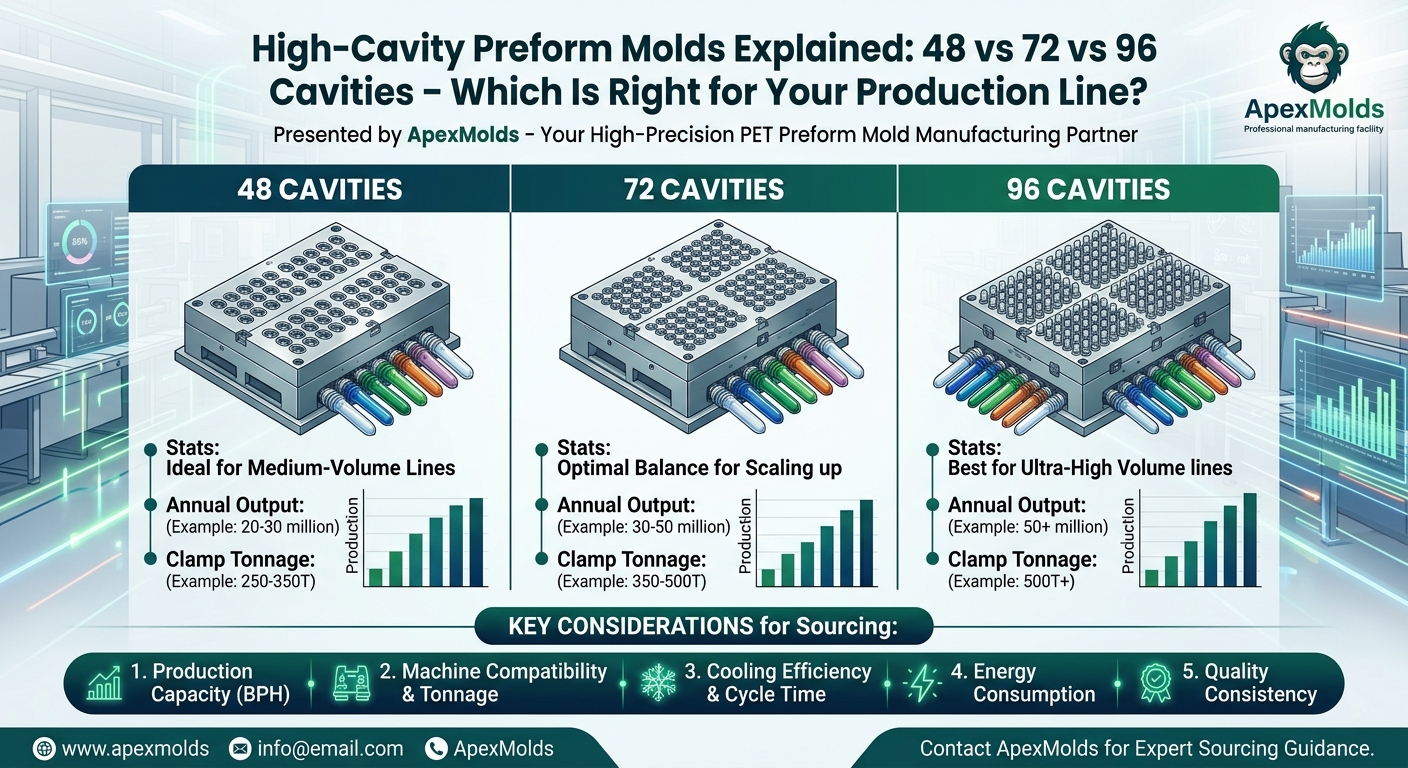
High-Cavity Preform Molds Explained: 48 vs 72 vs 96 Cavities – Which Is Right for Your Production Line?
In high-volume PET container manufacturing, scale efficiency is the ultimate driver of profitability. Transitioning to high-cavity PET preform molds—specifically 48-cavity, 72-cavity, and 96-cavity configurations—allows beverage brands, water bottlers, and packaging converters to achieve massive hourly outputs while minimizing floor space footprint and unit production costs.
However, scaling cavity density isn't simply a matter of adding more cores to a mold platen. Higher cavity counts introduce complex dynamic challenges in melt distribution, clamp tonnage requirements, cooling uniformities, and initial capital expenditure. At ApexMolds, as a premier professional PET preform mold manufacturer, we specialize in high-precision, valve-gate multi-cavity solutions engineered for seamless continuous production. This technical guide provides a rigorous engineering comparison to help you select the ideal cavity configuration for your injection moulding facility.
1. Comparative Engineering Matrix: 48 vs. 72 vs. 96 Cavity Molds
Evaluating multi-cavity options requires balancing machine specifications, thermal control, and output targets. Below is an operational benchmark across the three key high-density configurations:
| Engineering Parameter | 48-Cavity Preform Mold | 72-Cavity Preform Mold | 96-Cavity Preform Mold |
|---|---|---|---|
| Target Hourly Yield (approx.) | 14,000 – 18,000 PPH | 22,000 – 28,000 PPH | 30,000 – 38,000+ PPH |
| Required Clamp Tonnage | 280T – 350T | 400T – 500T | 500T – 650T+ |
| Hot Runner Valve Zones | 12 – 24 Individual Zones | 24 – 36 Individual Zones | 48+ Precision Control Zones |
| Typical Neck Finish Range | 28mm, 38mm, 48mm, Wide-Mouth | 26/22, 29/25, PCO 1881 | Micro-Weight 26/22, 29/25 Water Necks |
| Primary Market Application | Regional Bottlers, CSD, Edible Oil | High-Speed Water & CSD Lines | Mega Bottling Plants, Global Brands |
2. Deep-Dive Analysis of Each Cavity Platform
A. 48-Cavity Preform Molds: The Industry Workhorse
The 48-cavity platform represents the optimal balance between high production volume and operational flexibility. It is widely compatible with mid-to-large tonnage standard injection moulding machines.
- Key Advantage: Lower entry capital cost while delivering high output. Excellent flexibility for frequent mold changes between different bottle weights or neck dimensions (e.g., changing from PCO 1881 to 38mm juice necks).
- Best Suited For: Medium-to-large packaging plants running multiple bottle SKUs or regional beverage lines.
B. 72-Cavity Preform Molds: The High-Efficiency Sweet Spot
As water and soft drink production speeds increase globally, the 72-cavity mold has emerged as the preferred industry standard for high-density production without requiring massive 800-ton injection systems.
- Key Advantage: Delivers a 50% capacity jump over 48-cavity systems with only a incremental increase in machine clamping footprint. Highly efficient energy-to-output ratio.
- Best Suited For: Dedicated high-speed water lines, carbonated soft drink (CSD) operations, and large-scale preform exporters.
C. 96-Cavity Preform Molds: Ultra-High Volume Dominance
Representing state-of-the-art PET injection tooling engineering, the 96-cavity platform is designed for non-stop, continuous mass production environments.
- Key Advantage: Lowest per-unit production cost achievable. Combined with rapid post-mold cooling (take-out robots), 96-cavity molds deliver unmatched economies of scale.
- Engineering Requirements: Demands ultra-precise melt balance, robust machine platen rigidity, and strict cooling water quality to maintain less than 0.05mm concentricity across all 96 cavities.
- Best Suited For: Global beverage giants and high-capacity contract manufacturers operating 24/7 dedicated single-SKU production lines.
3. Critical Engineering Considerations for High-Cavity Molds
When operating 48, 72, or 96 cavities, minor engineering flaws can result in severe quality variations or costly downtime. ApexMolds solves these critical challenges through advanced tool design:
A. Thermal Balance and Hot Runner Precision
In high-cavity layouts, maintaining equal melt temperature and flow length to every gate is vital. ApexMolds integrates custom pneumatically-actuated valve-gate hot runner systems with balanced manifold channel designs. This ensures identical filling speeds, eliminates gate tailing, and keeps Acetaldehyde (AA) levels strictly within international beverage standards.
B. Advanced Conformal Cooling Systems
Cooling accounts for over 60% of the preform molding cycle. ApexMolds utilizes premium Swedish S136 stainless steel cores and cavities featuring optimized internal water cooling circuits. This maximum heat dissipation efficiency ensures rapid cycle times without inducing preform warpage or uneven thermal shrinkage.
C. Interchangeability and Maintenance Design
To minimize factory downtime during maintenance, ApexMolds crafts core, cavity, and neck ring stack components using high-precision CNC machining. Every component is 100% interchangeable, allowing on-site replacement without requiring extensive hand-fitting or re-grinding.
Conclusion: Selecting Your Optimal Path Forward
Choosing between a 48, 72, or 96-cavity preform mold requires evaluating your annual production targets, machine clamping specs, energy tariffs, and product mix flexibility. For versatile multi-SKU lines, a 48-cavity mold provides maximum adaptability. For mass-market water and CSD production, 72-cavity and 96-cavity molds offer the highest yield and fastest long-term ROI.
Looking to upgrade your PET preform production line or analyze ROI for high-cavity tooling? Contact the engineering specialists at ApexMolds today for tailored mold designs and technical consultation.