
Hot Runner vs Cold Runner for PET Preform Molds: Which One Saves More Cost?
In high-volume plastic packaging production, processing costs are measured in fractions of a cent per unit. For PET preform production, one of the most critical structural decisions made during the injection mold procurement phase is selecting the right melt distribution system. The debate between Hot Runner vs Cold Runner for PET Preform Molds ultimately comes down to a comprehensive analysis of initial expenditure versus long-term operational efficiency.
As a global professional PET preform mold solution expert, Apexmolds delivers a deep technical breakdown comparing these two feed systems to determine which configuration offers the lowest Total Cost of Ownership (TCO) for your specific manufacturing scale.
1. Technical Definitions: Hot Runner vs. Cold Runner Systems
To evaluate cost benefits accurately, we must first look at the mechanical differences and material behaviors within the injection molding cycle.
Cold Runner Systems in PET Molding
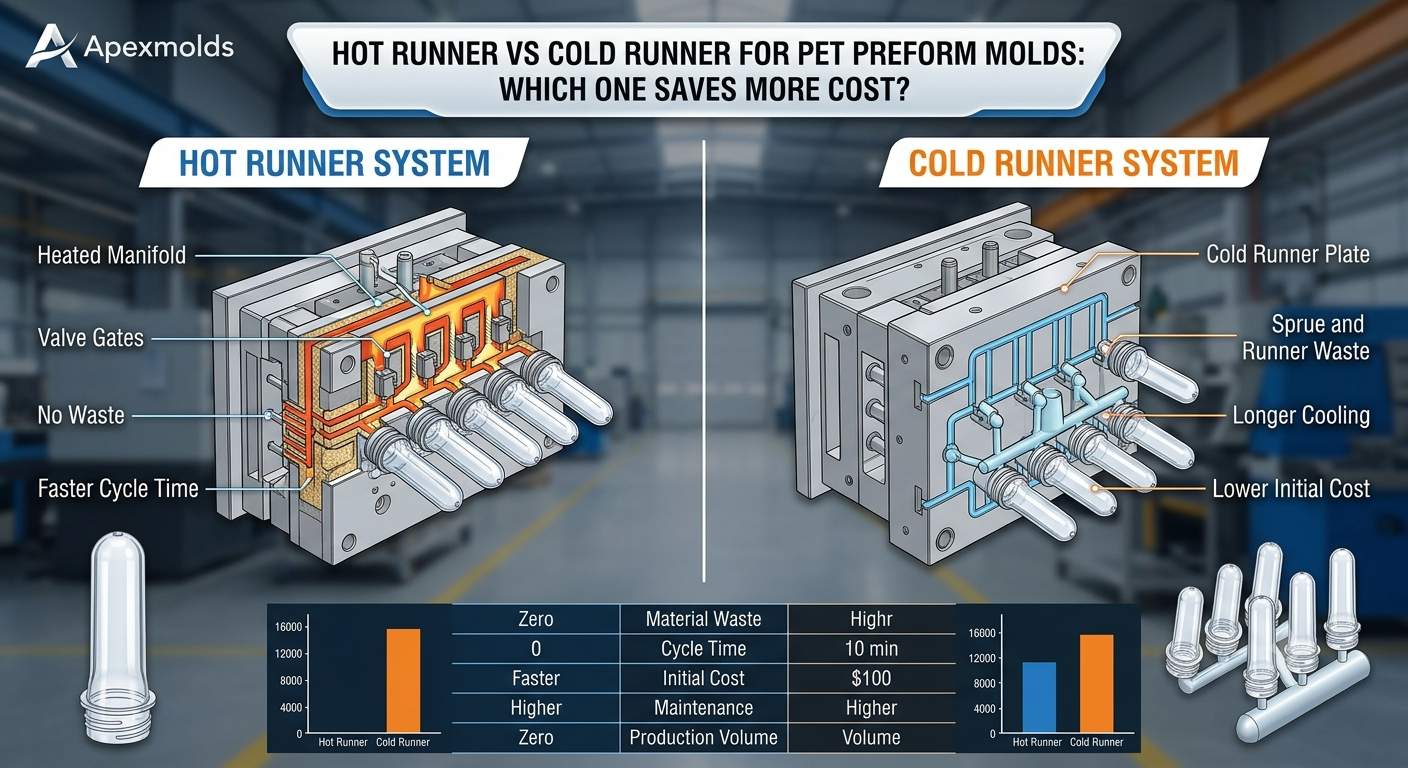
In a cold runner system, the molten PET resin travels from the injection machine nozzle through a physical channel (sprues and runners) cut into the mold plates. The runner grid cools and solidifies along with the preforms during every single cycle. Upon mold separation, the solid plastic runner is ejected alongside the preforms. While these runners can be crushed and re-granulated (regrind), this extra step consumes significant energy and introduces the risk of material contamination.
Hot Runner Systems in PET Molding
Conversely, a hot runner system features internally or externally heated manifold components and nozzles embedded inside the mold plates. The PET resin inside these channels remains in a molten state continuously, even during the cooling and ejection phases of the preforms. Only the plastic inside the cavity forms the actual preform. At Apexmolds, we engineer advanced valve-gated hot runner systems that use pneumatic or hydraulic pins to mechanically shut off the gate point, completely eliminating stringing and leaving a perfectly flush gate vestige.
2. Deep Cost Analysis: CapEx vs. OpEx Breakdown
Determining which system saves more cost requires balancing initial capital investment (CapEx) against ongoing operational expenses (OpEx).
A. Material Waste & Scrap Re-processing Costs (OpEx Advantage: Hot Runner)
PET resin prices account for approximately 65% to 75% of the total production cost of a bottle preform. In a cold runner system, the runner network can add 15% to 30% to the total shot weight. Re-processing this scrap into regrind demands secondary machinery (granulators, dust extractors), extra labor, and electricity. Furthermore, using regrind degrades the intrinsic viscosity (IV) of the PET resin, risking optical clarity issues like yellowing or haze. Hot runner systems generate zero runner waste, feeding 100% of the virgin resin into the finished preform.
B. Cycle Time and Energy Efficiency (OpEx Advantage: Hot Runner)
In cold runner setups, the cycle time is strictly dictated by the thickest part of the runner grid, which must solidify enough to be ejected cleanly. This delays the extraction phase. A hot runner eliminates the runner cooling phase entirely. An Apexmolds hot runner system can reduce the total injection cycle by 20% to 35%. Shorter cycle times mean you yield significantly more preforms per hour on the same machine, lowering the per-part amortization rate of factory overhead and power consumption.
C. Initial Investment & Maintenance Costs (CapEx Advantage: Cold Runner)
Cold runner molds have simpler designs, requiring fewer machining hours and zero electrical heating components, making their initial price point significantly lower. A hot runner mold features sophisticated temperature controllers, internal thermocouples, manifold blocks, and specialized valve pins. This increases initial tooling procurement costs and requires technicians trained in electrical and thermal diagnostics for preventative maintenance.
3. Engineering Decision Matrix
Apexmolds utilizes the following engineering matrix to determine the most cost-effective solution based on customer metrics:
| Financial & Technical Factors | Cold Runner PET Mold | Hot Runner PET Mold (Apexmolds Design) |
|---|---|---|
| Initial Tooling Cost (CapEx) | Low to Moderate | Higher Premium Investment |
| Resin Waste (Runner Scrap) | 15% - 30% per shot | 0% (Zero Scrap) |
| Average Injection Cycle Time | 18 - 28 seconds | 9 - 15 seconds (High-Speed Performance) |
| Preform Optical Quality | Variable (Regrind risks contamination) | Premium (Virgin resin thermal balance) |
| Recommended Production Volume | < 1 Million units annually | > 5 Million units annually (Mass production) |
4. The Verdict: Which System Saves More Cost?
For low-volume production runs, custom prototypes, or operations handling frequent color or design changes, a cold runner mold offers an affordable barrier to entry and lowers initial startup risk.
However, for medium to high-volume commercial production, the hot runner system achieves a rapid return on investment (ROI). The elimination of material scrap, reduction in processing steps, and significantly faster cycle times allow a hot runner PET mold to pay for its initial cost premium within the first few months of continuous operation.
Partner with Apexmolds: Your Professional PET Tooling Experts
At Apexmolds, we specialize in maximizing your production margins. Our custom hot runner manifolds feature optimal rheological balance, ensuring perfectly uniform thermal distribution and consistent shot weights across all cavities. Whether you need a 16-cavity hot runner system for rapid payback or an ultra-precise high-cavity mass production setup, our technical team provides the engineering expertise to optimize your manufacturing costs.
Contact the Apexmolds engineering department today for an absolute cost-per-part simulation and find the perfect tooling architecture for your facility.