
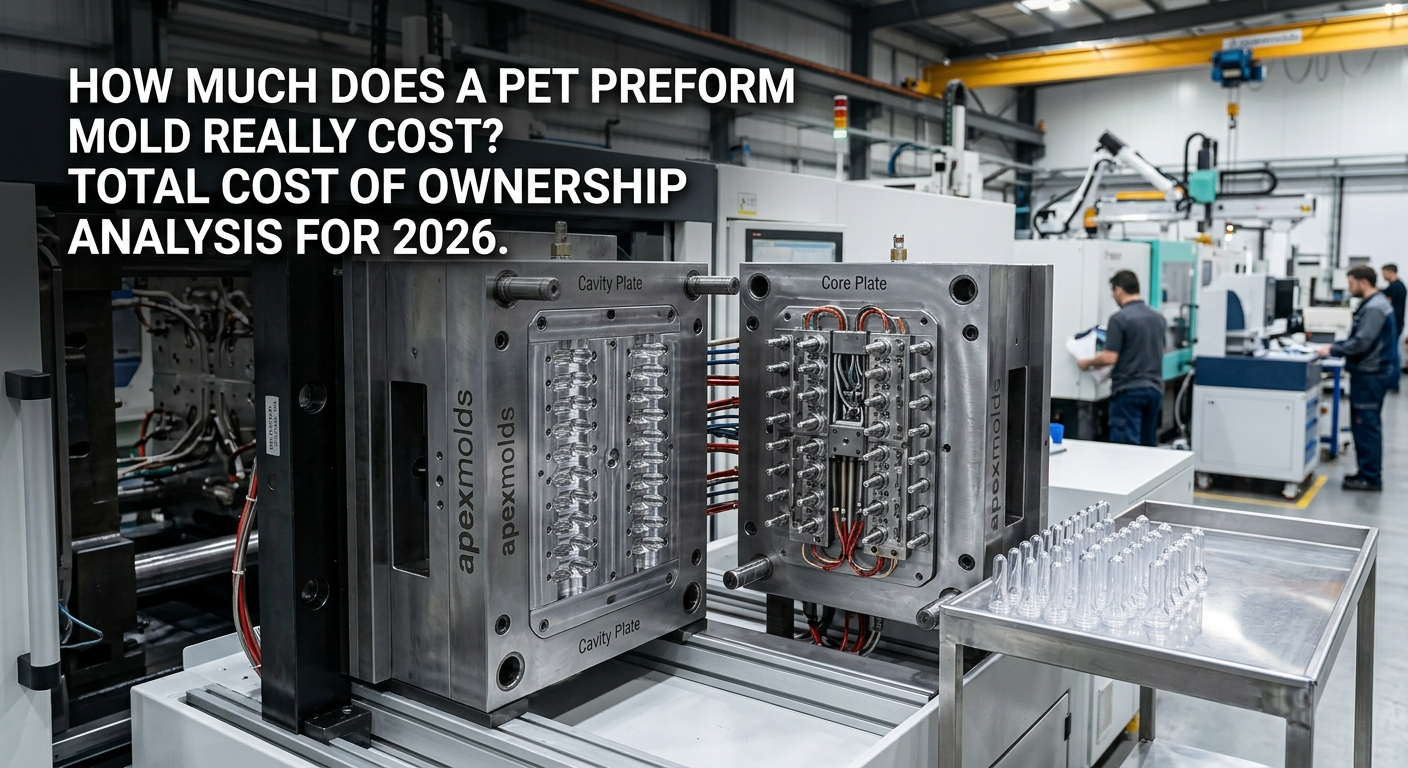
How Much Does a PET Preform Mold Really Cost? Total Cost of Ownership Analysis for 2026
In high-volume beverage packaging and plastic bottle manufacturing, evaluating the cost of a PET preform mold purely by its initial purchase price is one of the most expensive mistakes a procurement team can make. While a lower upfront quote may look attractive on a capital expenditure (CAPEX) sheet, hidden operational expenditures (OPEX)—such as frequent downtime, long cycle times, high reject rates, and excessive energy consumption—can quickly multiply the real cost of ownership within the first year of operation.
As industry standards evolve in 2026 toward higher cavity density, lightweighting, and high-percentage rPET integration, ApexMolds helps beverage brands and packaging converters look beyond the sticker price. This technical analysis breaks down the true Total Cost of Ownership (TCO) of PET preform molds, providing a clear ROI framework for modern procurement and engineering teams.
1. Breaking Down the Cost Formula: CAPEX vs. OPEX in PET Tooling
The lifetime cost of a PET preform mold consists of two distinct components: initial purchase price (CAPEX) and continuous production efficiency (OPEX). Over a standard 5-to-10-year mold lifespan, initial tooling costs typically account for less than 15% of the total money spent operating that mold.
| Cost Category | Low-Cost Standard Tooling | ApexMolds High-Precision Tooling Platform | TCO & Financial Impact |
|---|---|---|---|
| Initial Tooling Cost (CAPEX) | Lower (15% – 25% lower initial price) | Standard Premium Investment | Higher upfront, significantly lower long-term cost |
| Core/Cavity Steel Grade | Standard P20 / Low-grade Stainless Steel | Hardened Swedish S136 Stainless Steel (HRC 48-52) | 5M+ cycles lifetime vs. frequent surface re-polishing |
| Average Injection Cycle Time | 11.5 – 13.0 seconds | 8.5 – 10.0 seconds (Conformal Cooling) | Up to 25% more hourly output on the same machine |
| Scrap & Defect Rate | 2.5% – 4.0% (Flash, gate tailing, eccentricity) | < 0.3% (Precision pneumatic valve gate) | Saves tens of thousands of dollars in wasted resin annually |
| Maintenance & Downtime | High (Frequent seal replacements & cleaning) | Low (Interchangeable plug-and-play components) | Maximum plant uptime and continuous production yield |
2. Key Technical Factors Driving the Real Cost of a Preform Mold
When calculating the true cost of PET preform tooling, four major engineering pillars determine whether a mold generates long-term profit or operational losses:
1. Hot Runner Architecture & Gate Precision
Inexpensive open-gate or poorly balanced hot runners generate long gate stems and excessive thermal shear, causing high Acetaldehyde (AA) levels and stringing. ApexMolds integrates multi-zone pneumatic valve-gate hot runners that guarantee a flush (<0.1mm) gate finish. This eliminates manual trimming, prevents downstream blow molding failure, and supports smooth processing of virgin PET and rPET blends.
2. Thermodynamic Cooling Control & Cycle Efficiency
Cooling accounts for more than 60% of the injection cycle. Cheap cooling designs lead to localized hot spots, forcing operators to extend holding and cooling times. ApexMolds incorporates high-velocity 360-degree conformal cooling around neck rings and cores, shaving 1.0 to 2.5 seconds off every stroke. In high-density platforms (such as 48-cavity, 72-cavity, or 96-cavity molds), a 1-second cycle reduction yields millions of additional preforms per year without adding machinery.
3. Machining Tolerances & Concentricity
Poor core-to-cavity alignment results in wall thickness variation (eccentricity). Even a 0.08mm deviation causes uneven heat distribution during stretch blow molding, leading to thin-wall bottle bursting. ApexMolds utilizes multi-taper self-locking core structures precision-machined to within ±0.03mm, ensuring strict material symmetry and allowing aggressive preform lightweighting.
4. Interfacing and Component Interchangeability
Non-standardized or hand-fitted mold components require extensive manual labor and custom grinding when a cavity is damaged. ApexMolds manufactures 100% interchangeable stack components (cores, cavities, neck rings, valve pins), enabling fast, plug-and-play field replacement in minutes to minimize factory downtime.
3. 2026 ROI Calculation Example: The True Value of ApexMolds Engineering
Consider a bottling plant operating a 72-cavity PET preform mold on a continuous 24/7 schedule producing 20g mineral water preforms:
- Cycle Time Reduction: Reducing cycle time from 11.0 seconds to 9.5 seconds increases annual capacity by approximately 13.6 million preforms on a single line.
- Resin & Scrap Savings: Lowering the scrap rate from 3.0% to 0.3% saves over 45 metric tons of PET resin per year.
- Payback Horizon: Despite a modest premium in initial CAPEX for precision steel and advanced hot runners, the operational savings fully amortize the investment within 8 to 12 months.
Conclusion: Partnering with ApexMolds for Maximum Lifetime Value
In 2026, answering "How much does a PET preform mold cost?" requires looking beyond the quotation page. Superior steel metallurgy, optimized hot runner flow balance, and precision cooling engineering dictate your unit production cost for years to come. ApexMolds engineers high-durability, fast-cycle PET preform molds designed to deliver the lowest Total Cost of Ownership and the highest return on investment in the industry.
Looking to calculate the TCO or request a custom ROI proposal for your next preform mold project? Contact the technical specialists at ApexMolds today.