
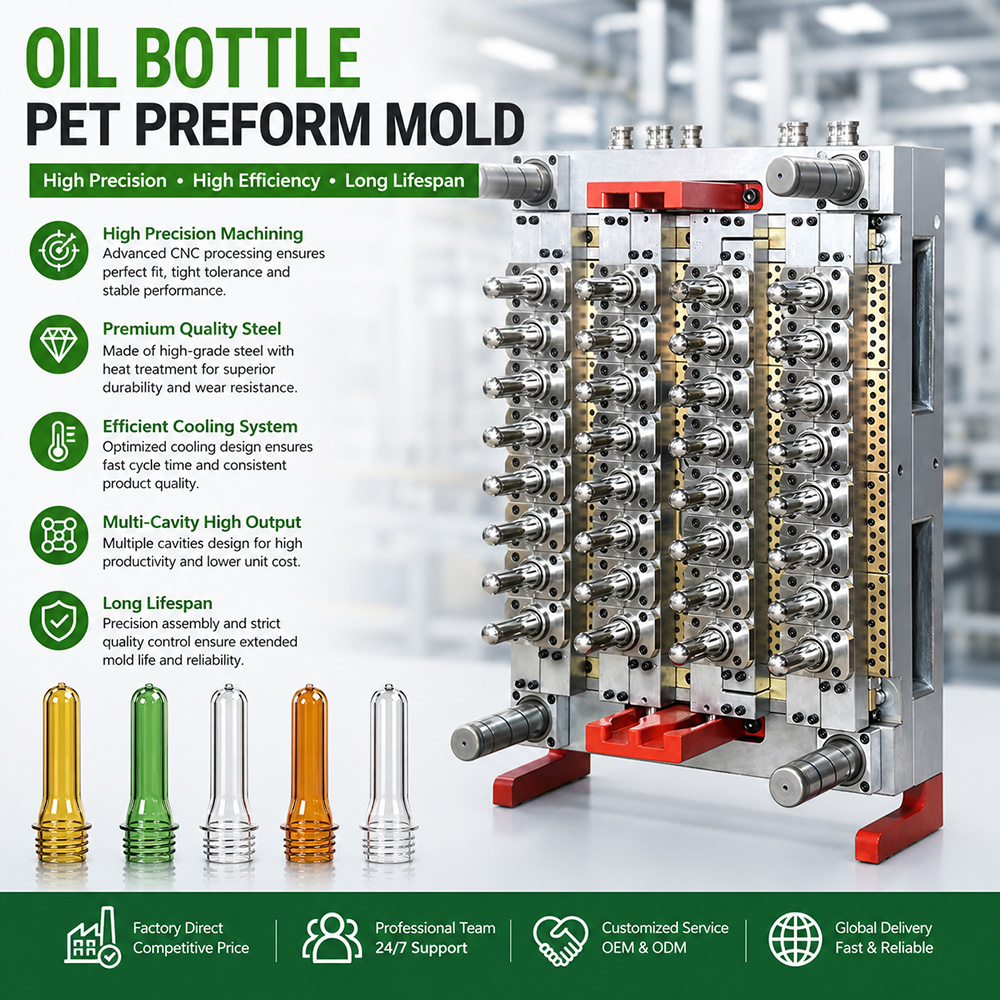
How to Choose a High-Cavity Preform Mold Manufacturer: Technical Capabilities to Evaluate
Published by apexmolds Technical Engineering Team
Introduction: The Critical Role of Tooling in PET Packaging Success
In high-volume PET container manufacturing, the quality of the preform dictates the consistency, burst strength, and aesthetic appeal of the final blown bottle. For brand owners and packaging converters deploying high-cavity systems (ranging from 72 to 144 cavities), selecting the right preform mold manufacturer is a strategic decision that directly influences operating margins, OEE (Overall Equipment Effectiveness), and long-term profitability.
As a specialized engineering leader in PET preform tooling, apexmolds partners with global manufacturers to deliver high-performance, precision-engineered mold systems. This technical guide outlines the essential evaluation criteria engineering managers must consider when vetting a high-cavity preform mold supplier.
1. Core Material Selection and Heat Treatment Expertise
The rigorous demands of high-speed injection molding require mold steels that can withstand millions of cycles under high clamping tonnage and abrasive polymer flow without dimensional degradation.
- Preform Core & Cavity Steels: Premium preform molds utilize high-grade pre-hardened stainless steel (such as specialized grades equivalent to S136 or DIN 1.2316) featuring superior corrosion resistance and high thermal conductivity.
- Neck Finish Durability: The threaded neck split inserts experience severe mechanical wear during the opening and closing phases. Look for manufacturers utilizing advanced vacuum heat treatment processes to achieve surface hardness levels exceeding 50–52 HRC while maintaining a tough, shock-resistant core.
2. Hot Runner System Design and Thermal Balancing
Thermal stability across every cavity is the holy grail of high-cavity preform tooling. Even minor temperature variances across a 96-cavity manifold can lead to severe discrepancies in acetaldehyde (AA) generation, intrinsic viscosity (IV) drop, and wall thickness uniformity.
When evaluating a manufacturer, verify their capabilities in:
- Rheological Flow Simulation: Utilizing advanced CAE software to model melt flow behavior, pressure drops, and shear rates inside the hot runner manifold.
- Independent Zone Temperature Control: Ensuring precise multi-zone PID controllers maintain melt temperature variations within a strict tolerance window of less than ±0.5°C across all manifold tips.
- Balanced Flow Channels: Designing naturally balanced runner layouts to ensure identical residence time and fill pressure for every individual cavity.
3. Precision Machining and Interchangeability Standards
High-cavity molds demand microscopic tolerances to ensure that preform wall thickness remains uniform (typically within a variation of less than 3%). If a core or cavity component gets damaged during operation, replacing it should not require custom hand-fitting or a complete mold recalibration.
apexmolds employs high-precision 5-axis CNC machining centers, high-speed coordinate measuring machines (CMM), and automated optical inspection systems to guarantee 100% component interchangeability. This commitment drastically reduces maintenance downtime and simplifies spare parts management on the factory floor.
Conclusion: Partner with apexmolds for Reliable High-Cavity Performance
Choosing a preform mold manufacturer goes beyond comparing initial purchase prices. It requires evaluating metallurgical integrity, thermal engineering sophistication, and post-sale technical support. By partnering with apexmolds, packaging producers gain access to world-class tooling solutions engineered to maximize cycle speed, minimize scrap rates, and secure long-term operational success.