
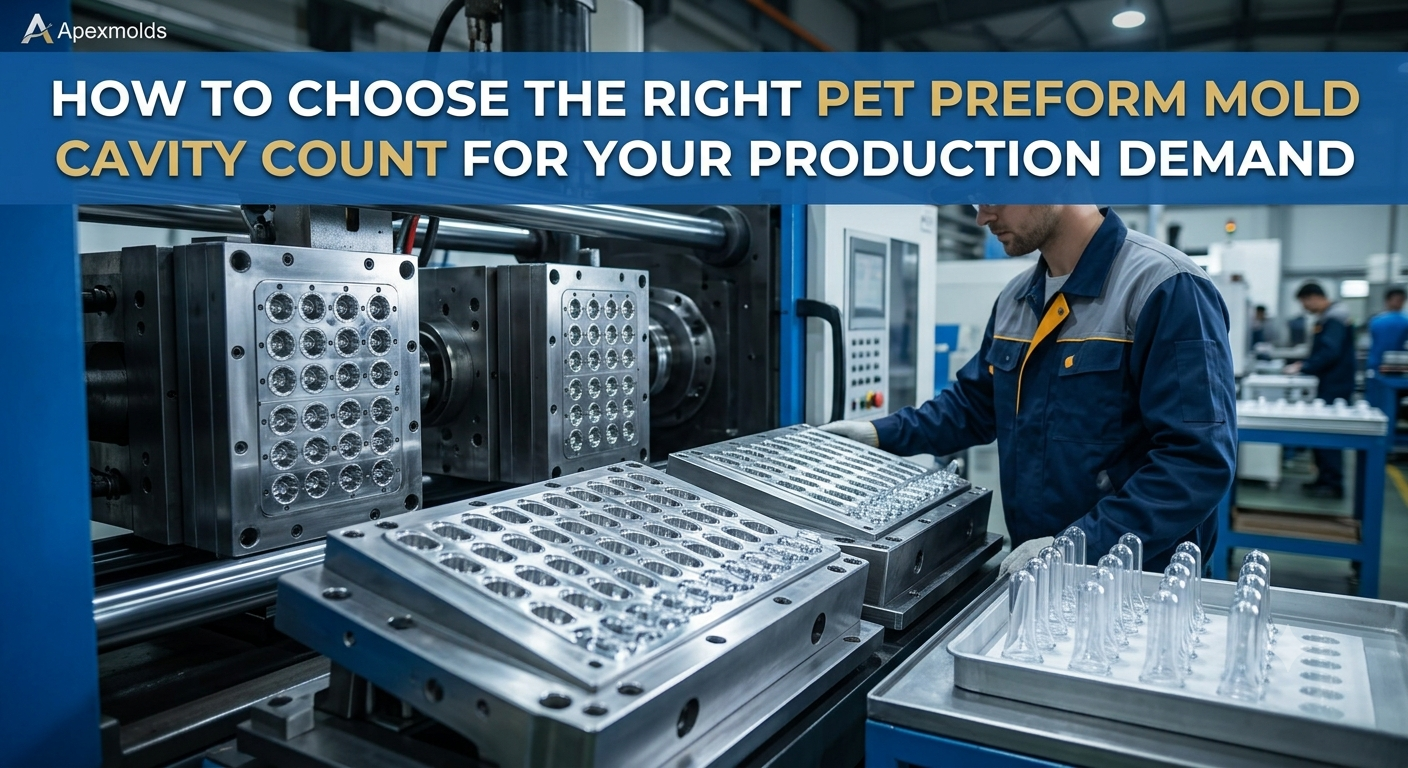
How to Choose the Right PET Preform Mold Cavity Count for Your Production Demand
In the high-speed PET packaging industry, maximizing production efficiency while minimizing unit costs is the ultimate goal. For bottle manufacturers and plastic packaging producers, the most critical decision during the project planning stage is choosing the optimal PET preform mold cavity count.
Selecting too few cavities can lead to missed production deadlines and high piece-part costs. Conversely, over-specifying the cavity count increases initial capital expenditure (CapEx) and requires a massive, high-tonnage injection molding machine (IMM) that can drain utility budgets. As a leading professional PET preform mold manufacturer, Apexmolds breaks down the key technical and economic parameters to guide your tooling decision.
1. Machine Compatibility: Clamping Force & Shot Capacity
Your choice of mold cavity count is strictly bound by the specifications of your Injection Molding Machine (IMM). To prevent parting-line flash, the machine's clamping force must exceed the total opening pressure exerted by the injected PET resin.
The Tonnage Formula
A standard formula used by Apexmolds' engineers to estimate required clamping force is:
Required Clamping Force (Tons) = [Total Projected Area of Cavities + Runners (cm²)] × Material Tonnage Factor (t/cm²) × Safety Margin (1.10)
For PET resin, the typical pressure factor ranges between 0.5 to 0.7 t/cm² depending on the wall thickness and flow path length. High-cavity molds (such as 48-cavity, 72-cavity, or 96-cavity molds) multiply the projected area exponentially, requiring larger IMM clamping units (e.g., 300 to 500+ tons).
Shot Weight Capacity
The total weight of the shot (preform weight × cavity count + hot runner manifold volume) should ideally fall between 40% and 75% of the machine's maximum shot capacity. Operating below 40% leads to PET degradation due to excessive residence time in the barrel, while exceeding 75% can result in inconsistent plasticizing and uneven filling.
2. Key Technical Parameters: Preform Geometry and Pitch
The structural design of the preform dictates how closely the cavities can be nested together within the mold base. Two physical factors determine the maximum possible cavity count for a given mold footprint:
- Neck Diameter: Large neck finishes (e.g., 38mm or 48mm for wide-mouth jars) require a larger cavity pitch (the distance between cavity centers). This limits the maximum number of cavities that can fit into a standard machine's tie-bar spacing.
- Wall Thickness & Cycle Time: Thick-walled preforms (used for heavy hot-fill or cosmetic bottles) require longer cooling times. If your cycle time is inherently long, a higher cavity count is needed to meet your daily production volume.
3. Hot Runner System and Thermal Balance
At Apexmolds, we engineer advanced hot runner systems with balanced manifold designs. The complexity of balancing melt flow and temperature increases dramatically with cavity count:
- Low-to-Medium Cavity Molds (8 to 24-cavities): Easier to manage thermally and hydraulically. Excellent for short production runs or localized markets.
- High-Cavity Molds (48 to 144-cavities): Require highly sophisticated hot runner manifolds with balanced flow channels and pneumatic valve gate systems to ensure identical weight, dimension, and physical properties across all preforms.
4. Economic ROI: CapEx vs. OpEx Analysis
To determine the most profitable cavity configuration, you must balance the initial investment (Tooling + Machine) against your long-term operational costs (labor, energy, yield). Use this comparison guide based on common production demands:
| Production Scale | Recommended Cavity Count | Best Fit Applications | Capital Investment (CapEx) | Operational Efficiency (OpEx) |
|---|---|---|---|---|
| Low Volume | 1 to 16 Cavities | Startups, niche bottles, customized preforms, 5-gallon water jars | Low (Small IMM needed, affordable mold) | Higher cost-per-part, manual or semi-automated setup |
| Medium Volume | 24 to 48 Cavities | Regional mineral water, carbonated soft drinks (CSD), edible oils | Moderate (Medium-sized IMM with fast-cycling features) | Highly balanced ROI, excellent versatility |
| Mass Production | 72 to 144 Cavities | Multinational beverage brands, dedicated preform supply plants | High (Requires specialized high-speed PET injection system) | Lowest cost-per-part, maximum energy and labor efficiency |
Partner with Apexmolds: Your Professional PET Preform Solution Experts
Choosing the correct cavity count is not just a mathematical calculation; it is a strategic business decision. Selecting the wrong configuration can lead to bottlenecks or underutilized machinery.
At Apexmolds, we do not just sell molds; we provide complete production solutions. Our engineering team conducts comprehensive mold-flow analyses, cooling simulations, and IMM compatibility reviews to ensure your mold delivers the highest yield at the lowest cost per preform. Contact our technical team today to customize your high-performance PET preform mold layout.