
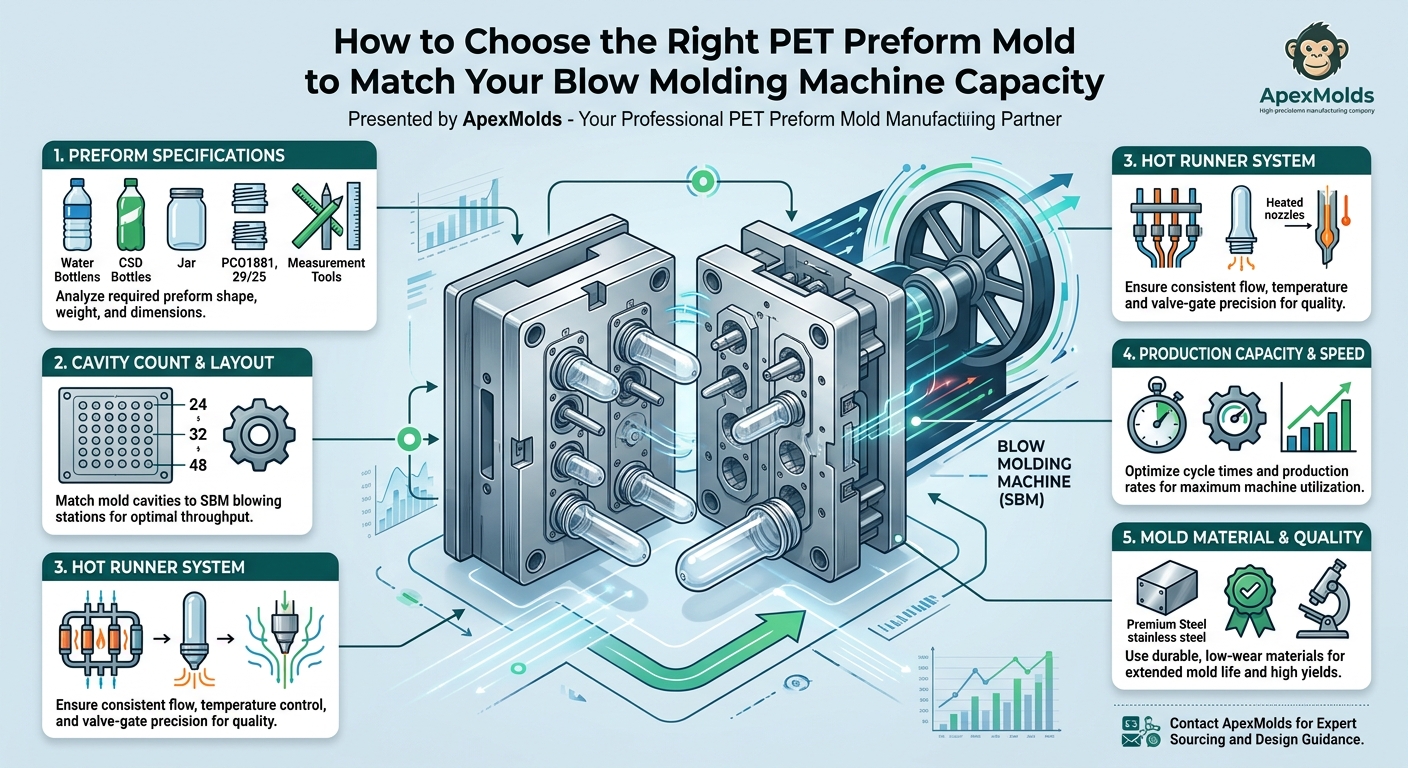
How to Choose the Right PET Preform Mold to Match Your Blow Molding Machine Capacity
In the PET packaging industry, achieving optimal production efficiency, low energy consumption, and high product yield requires seamless synergy between two critical components: the injection molding machine (or preform molding system) and the stretch blow molding machine (SBM). A common structural bottleneck faced by beverage and packaging manufacturers is a capacity mismatch—where the preform mold cavity count either starves the blowing machine or creates an unsustainable bottleneck in inventory and cycle times.
At ApexMolds, as a leading professional PET preform mold manufacturer, we specialize in high-precision, multi-cavity preform mold solutions engineered to balance downstream processing requirements. This technical guide outlines the precise engineering, mathematical calculations, and hardware considerations necessary to pair your PET preform mold with your blow molding machine capacity.
1. The Core Mathematical Model: Balancing Injection & Blow Molding Throughput
To establish a balanced production line, your preform manufacturing capacity (output per hour) must match or slightly exceed the maximum nominal capacity of your stretch blow molding machine.
A. Blow Molding Machine Output Calculation
Blow molding machine output is primarily determined by its heating/blowing stations and maximum cycle speed:
OutputBlowing (preforms/hour) = Blowing Cavities × (3600 / Blowing Cycle Time in seconds)
B. PET Preform Mold Output Calculation
Preform injection output depends on the mold cavity count and total injection cycle time (including cooling, robot pick-up, and core movement):
OutputInjection (preforms/hour) = Mold Cavities × (3600 / Injection Cycle Time in seconds)
The Golden Rule of ApexMolds Capacity Engineering:
OutputInjection ≥ OutputBlowing × 1.05 (Accounting for a standard 3%–5% operational scrap/rejection rate during blow molding restart and heating equilibration).
2. Matching Cavity Counts to Machine Scale
Selecting the right preform mold cavity configuration depends directly on the output speed of your stretch blow molding equipment (linear vs. rotary blow molders):
| Blow Molding Machine Type | Average Blowing Capacity (BPH) | Recommended ApexMolds Preform Mold Configuration | Typical Application Range |
|---|---|---|---|
| Semi-Automatic / Small Linear | 1,000 – 3,000 BPH | 4-Cavity to 8-Cavity Preform Mold | Jar & Wide-Mouth Containers, Small Batch Water |
| High-Speed Linear SBM | 4,000 – 8,000 BPH | 12-Cavity, 16-Cavity, to 24-Cavity Mold | CSD, Edible Oil, 500ml Water Bottles |
| High-Speed Rotary SBM System | 12,000 – 36,000+ BPH | 32-Cavity, 48-Cavity, to 64-Cavity Valve Gate Mold | Mass Beverage Lines, High-Volume CSD & Water |
3. Critical Technical Parameters for Seamless Mold-Machine Integration
A. Pitch, Tonnage, and Platen Dimensions
When selecting a mold for your existing injection molding machine, the clamping force and tie-bar distance must accommodate the selected cavity count. ApexMolds designs compact, high-efficiency molds utilizing premium Swedish S136 stainless steel for cores, cavity inserts, and neck rings, allowing higher cavity counts within standard machine platen dimensions.
B. Advanced Hot Runner System & Thermal Control
For high-capacity blowing machines, preform wall thickness consistency and gate quality are non-negotiable. ApexMolds integrates balanced hot runner systems with individual zone temperature control and pneumatic valve-gate technology. This minimizes AA (Acetaldehyde) levels, eliminates gate tailing, and guarantees uniform weight across all cavities, preventing burst bottles during high-pressure stretch blowing.
C. Optimal Cooling Efficiency and Cycle Speed
Cooling accounts for over 60% of the total preform injection cycle time. To increase preform capacity without increasing machine foot-print, ApexMolds utilizes optimized internal cooling water channels (conformal cooling technology) and post-mold cooling systems (take-out robots). This reduces cycle times significantly—allowing a 24-cavity or 32-cavity mold to yield output equivalent to larger standard systems.
4. Why Partner with ApexMolds for Your PET Preform Solution?
At ApexMolds, we are more than just a mold fabricator; we are end-to-end PET preform system architects. Our engineering approach guarantees that every mold delivered integrates effortlessly with your upstream injection units and downstream blowing lines.
- Precision Manufacturing: High-precision CNC machining ensures core and cavity concentricity within 0.05mm, preventing uneven wall distribution during blowing.
- Proven Trial Verification: Every mold undergoes rigorous factory acceptance testing (FAT), including 16-cavity, 24-cavity, 32-cavity, and 48-cavity trials to verify cycle stability before shipment[cite: 1, 3, 5, 7, 10].
- Tailored Neck & Weight Designs: From PCO 1881 and 29/25 water necks to wide-mouth jar preforms, our designs maximize stretch ratios for optimum bottle clarity and burst pressure strength[cite: 8, 9].
Conclusion: Maximize Yield with ApexMolds Engineering
Choosing the right PET preform mold is a balancing act between injection machine specifications, downstream stretch blow molding capacities, and overall production energy costs. Partnering with a specialized manufacturer ensures your line operates at peak efficiency with zero capacity bottlenecks.
Looking to optimize your PET preform production line or match a new mold to your blowing machine capacity? Contact the technical experts at ApexMolds today for custom engineering support.