
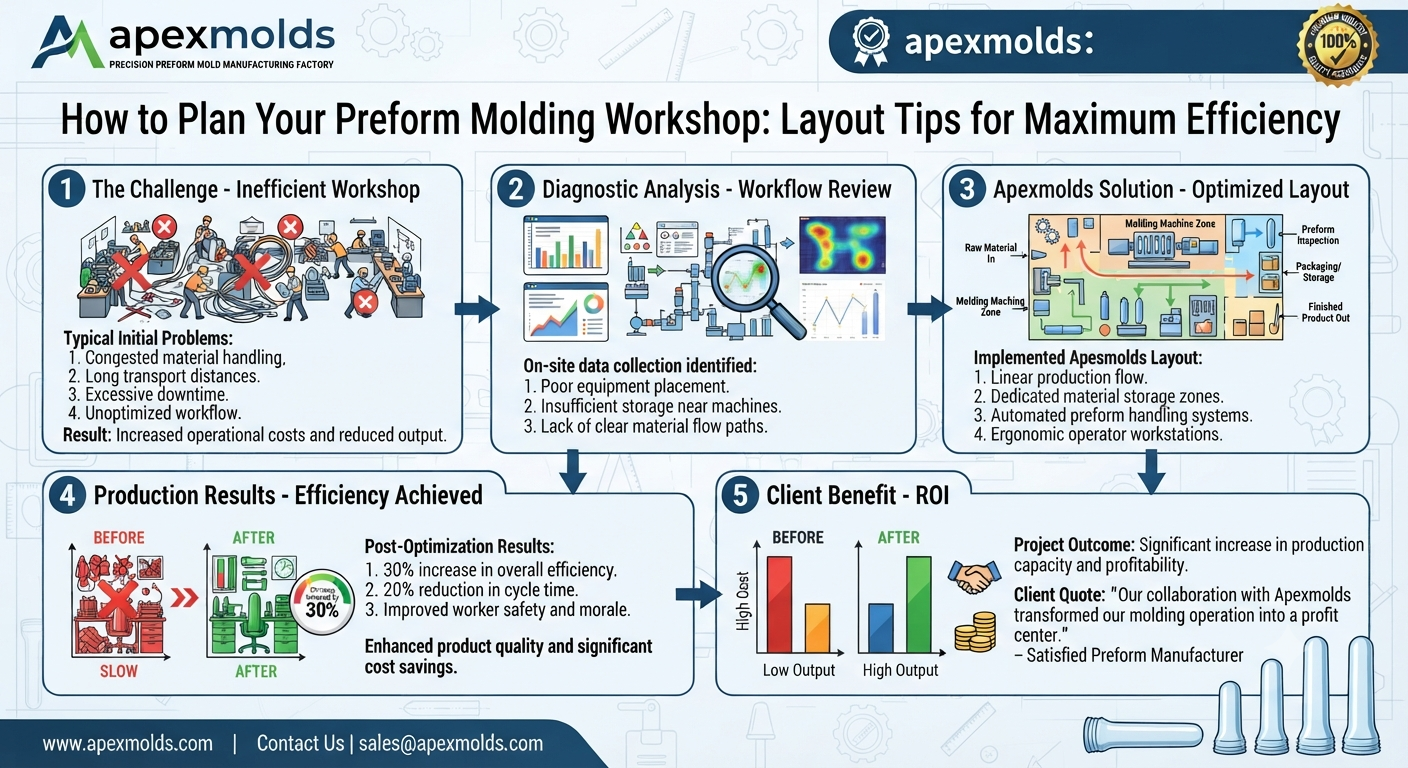
How to Plan Your Preform Molding Workshop: Layout Tips for Maximum Efficiency
In high-speed PET injection molding, plant profitability depends on more than just the speed of your machinery. While sourcing premium tooling is critical, the physical infrastructure surrounding those machines determines your long-term operational efficiency. A poorly planned plant floor layout leads to cross-contamination, excessive material handling, energy loss, and extended maintenance downtime.
Designing a layout for a PET preform production workshop requires a deep understanding of lean manufacturing, thermodynamics, and automated material workflows. As a global professional PET preform mold solution expert, Apexmolds shares this deep engineering analysis to help you optimize your workshop floor layout for maximum throughput and minimum waste.
1. The Four-Zone Lean Workflow Architecture
An efficient workshop layout eliminates backtracking. Raw materials and finished products must move in a continuous, unidirectional flow—typically following a U-shaped or straight-line (I-shaped) configuration. Apexmolds engineers recommend dividing your facility into four distinct functional zones:
- Zone 1: Raw Material Preparation & Drying: This area houses resin storage silos, vacuum feeding systems, and dehumidifying dryers. Because PET is highly hygroscopic, this zone should be closely coupled with, but thermally isolated from, the injection area to prevent moisture transfer.
- Zone 2: The Core Injection Molding Cells: This is the heart of the workshop, containing your injection molding machines (IMM), chillers, and PET preform molds. Space must be allocated for automated robots or take-out plates to safely strip preforms from the tooling.
- Zone 3: Automated Quality Control & Post-Cooling: Preforms exiting high-cavity molds often require secondary cooling conveyors or stabilization areas before final packaging to prevent thermal distortion and damage to the finish.
- Zone 4: Warehousing & Shipping Logistics: The final stage where finished boxes or octabins of preforms are sealed, labeled, and staged for distribution.
2. Engineering Utilities: Cooling, Chilling, and Air Piping
High-cavity PET preform molds (such as 48-cavity or 72-cavity molds) have extreme thermodynamic demands. Your workshop layout must place utility infrastructure as close to the injection cells as possible to minimize pressure drops and thermal losses along piping runs.
Dual-Circuit Cooling Pipeline Layout
Apexmolds designs molds that utilize independent internal circuits. Your plant layout must reflect this via two separated water supply systems:
Circuit A (Mold Cavity/Core): Requires chilled water at 8°C to 12°C with high volumetric flow rates to instantly quench the PET resin and eliminate milky white haze.
Circuit B (Machine/Hydraulics): Requires cooling tower water at 30°C to 35°C to stabilize hydraulic oil temperatures and hot runner manifold plates.
Locate the central chiller plant in an adjacent utility room with insulated overhead loop piping. Overhead piping loops maintain uniform pressure at every machine station, preventing pressure fluctuations that could compromise cooling efficiency in individual cells.
3. Tooling Maintenance and Overhead Crane Clearance
A major bottleneck in many preform production workshops is the lack of proper clearance for mold changes and preventative maintenance (PM). Precision PET preform molds are heavy, complex systems requiring specialized handling blocks.
- Overhead Crane Layout: The crane tracks must run perfectly parallel to the injection molding machines, covering the centerline of the clamping units. Ensure a minimum vertical clearance of 1.5 meters above the highest point of the IMM tie-bars to safely pull the core and cavity halves during a mold swap.
- Dedicated Mold Maintenance Cell: Set up a clean, climate-controlled workspace immediately adjacent to the injection floor. This room must feature heavy-duty workbenches, ultrasonic cleaning tanks for hot runner components, and regulated air lines to inspect and service delicate valve-gated assemblies away from shop-floor dust and debris.
4. Workshop Layout Specifications for Peak OEE
To maximize Overall Equipment Effectiveness (OEE) and ensure operator safety, follow these standardized spacing parameters engineered by Apexmolds:
| Layout Metric | Recommended Technical Standard | Engineering Objective |
|---|---|---|
| Inter-Machine Clearance | Minimum 1.8 to 2.5 meters | Allows safe core/cavity pulling, convenient technician access, and safe forklift or AGV tracking. |
| Material Feed Line Distance | Maximum vertical run < 15 meters | Minimizes material conveying delays, prevents resin degradation, and lowers vacuum pump energy load. |
| Air Ventilation Exchange Rate | 15 to 20 air changes per hour | Removes heat generated by hot runner systems and barrel heaters, maintaining a comfortable ambient climate. |
| Chilled Water Pipe Insulation | ≥ 25mm Polyurethane foam / rubber casing | Prevents atmospheric condensation from dripping onto precision mold faces and causing corrosion. |
Partner with Apexmolds: Your Turnkey Production Solution Experts
Setting up a highly efficient preform molding plant involves much more than connecting water lines and plugging in electricity. True cost savings are realized through the intelligent integration of thermodynamics, lean machine arrangement, and high-performance tooling design.
At Apexmolds, our engineering consulting extends beyond the mold base. We partner with packaging brands worldwide to deliver complete turnkey consulting—from initial workshop layout blue-printing and utility sizing simulations to installing high-cavity hot runner systems built for decades of continuous operation. Contact the Apexmolds technical advisory board today to design a high-efficiency production plant tailored to your market volume.