
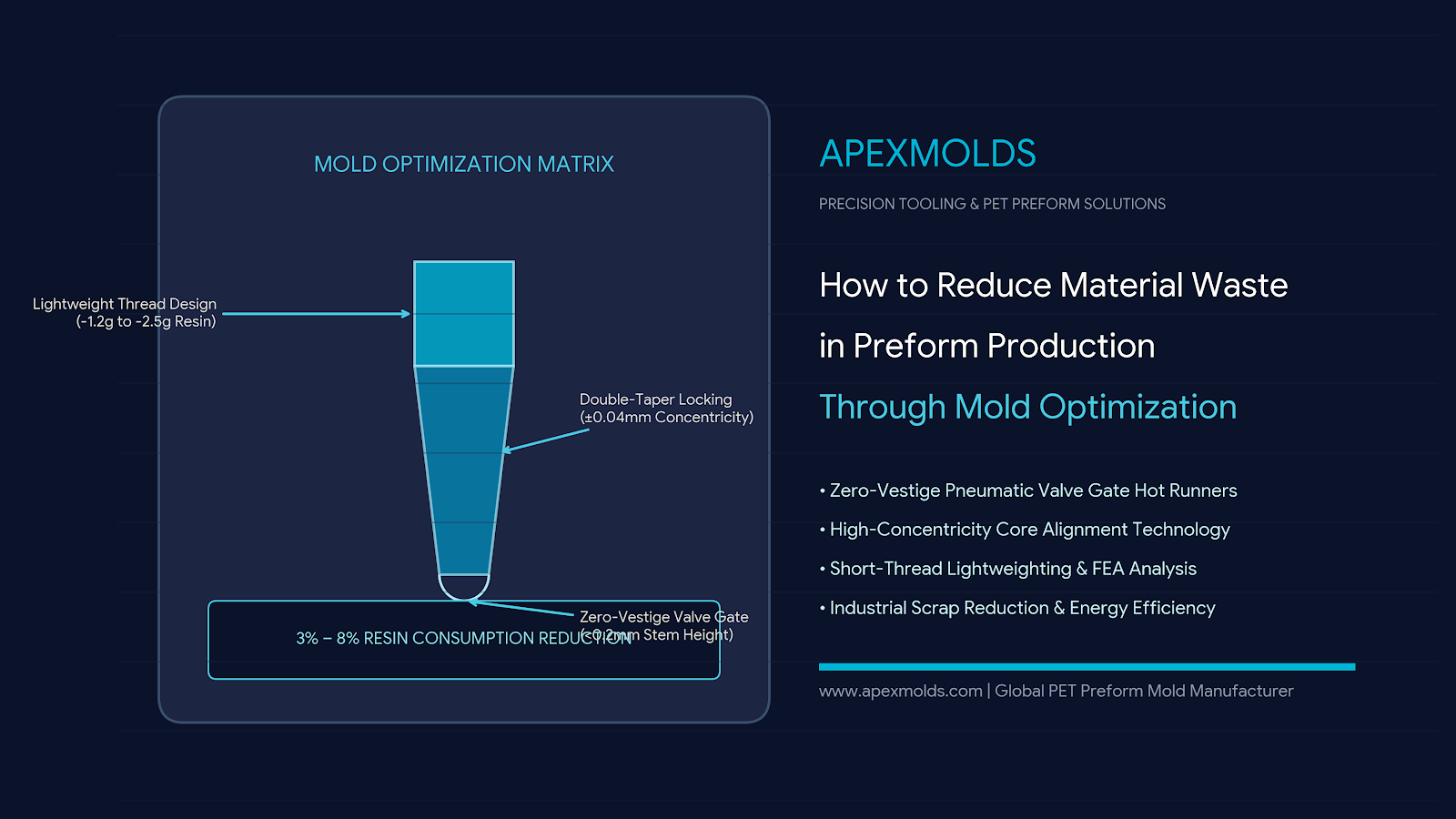
How to Reduce Material Waste in Preform Production Through Mold Optimization
In high-speed PET beverage packaging production, raw material (PET resin) accounts for up to 70% to 80% of total preform manufacturing costs. With escalating resin prices and stringent global environmental mandates targeting plastic consumption, reducing material waste is no longer just an environmental goal—it is a critical economic imperative for packaging converters.
While process parameters such as drying time and barrel temperature profiles are important, the primary driver of material efficiency is determined during the tooling design stage. Suboptimal mold alignment, hot runner stringing, flash generation, and inconsistent wall thickness create massive hidden resin waste. As a premier global PET preform mold manufacturer and turnkey solutions expert, Apexmolds breaks down the precise engineering mechanisms required to eliminate material waste through advanced mold optimization.
Core Technical Value: Minimizing material waste requires targeting both direct scrap (defects like gate nubs, flash, and off-center wall variations) and structural resin over-use. By optimizing valve gate shut-off mechanics, core concentricity alignment, and neck thread lightweighting, Apexmolds molds help packaging manufacturers lower annual resin consumption by up to 3% to 8% without compromising container burst strength.
1. Identifying the Four Major Sources of Resin Waste in Preform Molding
Before implementing engineering solutions, manufacturers must audit where PET material is routinely wasted during injection cycles:
- Gate Vestige & Stringing: Poor valve gate shut-off or thermal control causes long gate stems or stringing, creating defective preforms that jam downstream blowing machinery or require manual trimming.
- Wall Thickness Eccentricity (Core Drift): If the core rod shifts relative to the cavity during injection, wall thickness varies across the preform diameter. To meet minimum wall specifications on the thin side, manufacturers are forced to over-weight the entire preform.
- Parting Line Flash & Thread Deformities: Inaccurate mold plate lock-up or uneven thermal expansion leads to resin flashing at the neck ring or parting line, resulting in scrapped preforms.
- Downstream Stretch Blow Molding Scrap: Preforms with un-melted crystallinity, high Acetaldehyde (AA) localized spots, or uneven heat distribution fail during stretch blowing, generating unrecoverable bottle scrap.
2. Tooling Innovations: How Apexmolds Eliminates Material Waste
A. Zero-Vestige Pneumatic Valve Gate Hot Runner Systems
Conventional thermal sprue gates or poorly controlled valve gates leave sharp stem protrusions (vestiges) at the preform base. Apexmolds engineers a individual cylinder pneumatic valve gate system with precision-guided shut-off pins made of hardened steel alloys. This guarantees a smooth, flush gate vestige (typically <0.2mm stem height), eliminating gate stringing, pin breakage, and resin leakage entirely.
B. Self-Locking Double-Taper Structure for Extreme Concentricity
Core offset (eccentricity) is the leading cause of weight variation in preforms. Apexmolds incorporates a double-taper self-locking mechanism between the core, cavity, and neck ring split inserts. This rigid mechanical locking ensures that under high injection pressures (up to 140 bar), core drift is strictly controlled within ≤0.04mm. Maintaining concentric walls allows plants to safely reduce target preform weight without risking thin spots during blow molding.
| Material Waste Point | Standard Tooling Design Limit | Apexmolds Optimized Tooling Engineering | Resin & Cost Savings Impact |
|---|---|---|---|
| Gate Stem Vestige | 0.8 mm – 1.5 mm protrusion; frequent stringing | ≤ 0.2 mm flush gate cut with guided valve pins | Eliminates gate trim scrap & downstream blow jams |
| Wall Eccentricity | 0.08 mm – 0.12 mm variance (requires extra resin margin) | ≤ 0.04 mm concentricity via double-taper locking | 1.5% – 2.5% resin savings through weight precision |
| Parting Line Flash | Standard plate wear leads to neck ring flash | S136 stainless steel inserts (HRC 48–52) with zero-gap shutoff | Extends flash-free mold life over 5+ million cycles |
| Neck Finish Weight | Legacy bulky threads (e.g., PCO 1810) | Optimized lightweight neck finishes (PCO 1881 / 26mm) | 1.2g – 2.5g material reduction per preform |
C. Precision Neck Finish & Short-Thread Lightweighting
A significant portion of a preform's mass resides in the non-stretchable neck finish area. Apexmolds specializes in redesigning heavy neck profiles (such as PCO 1810 or standard oil finishes) into ultra-lightweight thread profiles (such as PCO 1881, 29/25, or 26/22 short finishes). By applying 3D finite element structural analysis (FEA), Apexmolds trims non-critical material from neck rings while ensuring seal tightness and capping torque integrity.
D. Balanced Rheological Flow to Prevent Localized Over-Filling
In high-cavity molds (e.g., 48, 72, or 96 cavities), unbalanced melt delivery causes inner cavities to over-pack while outer cavities fill slowly. Over-packed cavities contain excess material weight and high internal stress. Apexmolds hot runner manifolds feature naturally balanced 3D multi-level channel splitting, ensuring identical melt volume, flow rate, and pressure drop to every single cavity.
3. Quantifiable Financial Impact: Calculating Annual Resin Savings
The economic benefit of reducing material waste through mold optimization is best illustrated by a real-world high-volume packaging line comparison:
- Line Setup: 72-cavity PET preform mold running at a 10-second cycle time.
- Annual Production Volume: Approximately 200 million preforms per year.
- Baseline Preform Weight: 20.0 grams (running standard legacy tooling).
- Optimized Preform Weight: 18.8 grams (achieved through Apexmolds neck lightweighting + 0.03mm eccentricity control).
- Net Material Saving: 1.2 grams per preform = 240 Metric Tons of PET resin saved per year.
- Annual Financial Savings: At a resin cost of $1,100/ton, the annual savings exceed $264,000 USD—paying off the new Apexmolds tooling cost in just a few months.
4. Why Partner with Apexmolds for Material-Saving Tooling Solutions?
At Apexmolds, material efficiency is integrated into every stage of our engineering workflow. We combine certified Swiss S136 stainless steel construction, 3D mold flow rheology simulation, and precision CNC tolerances (±0.005mm) to deliver preform molds that run clean, fast, and light.
Whether you need to eliminate gate stringing on an existing line, lightweight an established bottle preform range, or deploy ultra-high-cavity (48 to 144 cavity) valve gate molds, Apexmolds provides end-to-end technical support—from product modeling and thermal flow optimization to complete turnkey commissioning.
Start Saving Resin & Reducing Preform Waste Today
Contact the Apexmolds technical engineering team to evaluate your current preform weight profiles, request a lightweighting feasibility report, or get a quotation for high-precision PET tooling.