
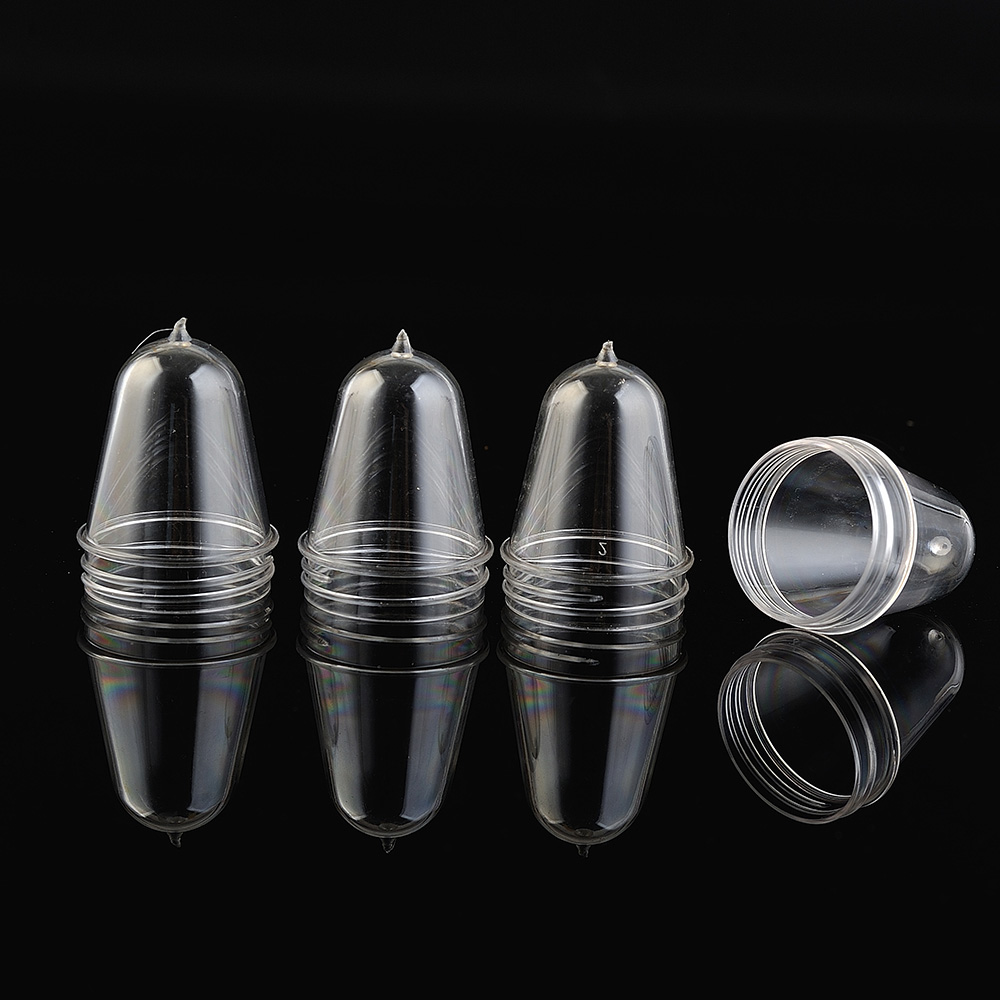
Lightweighting PET Preforms: How Mold Design Enables Gram Reduction Without Sacrificing Strength
In the highly competitive beverage and liquid packaging industry, material costs represent up to 70% of total preform manufacturing expenses. Consequently, lightweighting—reducing the resin weight of a PET preform by even a fraction of a gram—delivers massive annual cost savings across high-volume production lines. However, aggressive weight reduction often introduces severe quality risks: thin wall buckling, neck finish distortion, gate cracking, and compromised top-load or burst strength in the final blown bottle.
At ApexMolds, we prove that lightweighting does not require sacrificing structural performance. Through advanced FEA material simulation, dynamic wall-thickness distribution, and high-precision core-to-cavity alignment, our engineering team designs high-density preform molds that achieve significant gram reduction while preserving container strength. This technical whitepaper explores the critical mold design principles behind successful PET preform lightweighting.
1. The Mechanical Limits of Gram Reduction: Structural Risk Factors
When reducing resin volume, standard mold designs often struggle to maintain essential material distribution. Without precision engineering, gram reduction leads to critical failure points during injection and subsequent stretch blow molding:
- Wall Thickness Eccentricity: Core deflection during high-pressure injection causes uneven resin distribution, leaving thin spots that rupture during blow molding.
- Neck Finish Warpage: Reducing material in the neck threads (such as transitioning from PCO 1810 to lightweight PCO 1881 or tethered cap standards) can lead to thread ovality, causing seal leakage under capping torque.
- Stress Concentration at the Gate: Thinning the preform base without optimizing gate geometry creates high thermal and mechanical stress, leading to gate crystallization and base blowout during carbonated soft drink (CSD) pressurized filling.
2. Core Mold Design Strategies for High-Strength Lightweight Preforms
To overcome structural degradation, ApexMolds applies rigorous mechanical alignment and thermodynamic control techniques to ensure ideal stretch ratios and structural integrity in lightweight containers.
| Engineering Parameter | Standard Preform Mold Design | ApexMolds Lightweight Optimized Tooling | Structural & Economic Benefit |
|---|---|---|---|
| Core Concentricity Alignment | ±0.08mm allowable tolerance | Multi-taper self-locking system within ±0.03mm | Eliminates thin wall sections; ensures uniform stretch blow ratio |
| Transition Zone Geometry | Linear wall transitions | FEA-optimized parabolic radius curves at base & neck transition | Prevents top-load buckling and enhances hoop strength |
| Neck Ring Cooling Architecture | Series cooling circuit | Direct 360° high-velocity conformal cooling passages | Prevents thread shrinkage; guarantees gas-tight capping seal |
| Valve Gate Nozzle Control | Standard thermal gate shut-off | Pneumatic valve-gate shut-off with micro-step pin positioning | Creates clean, stress-free gate vestige (<0.1mm) to prevent base rupture |
Key Hardware Innovations Engineered by ApexMolds:
- Self-Locking Core Taper Design: ApexMolds incorporates precision multi-level taper positioning that mechanically locks cores and cavities into alignment prior to injection, eliminating core shift under high injection pressure.
- Swedish S136 Stainless Steel Stacks: Core and cavity inserts are crafted from hardened Swedish S136 stainless steel (HRC 48-52), polished to a mirror finish (
- Optimized Axial & Hoop Stretch Ratios: By modifying internal preform core geometry, ApexMolds optimizes material distribution so resin stretches efficiently into the bottle sidewalls and base panels, maximizing bi-axial orientation strength.
3. Proven Field Impact: Material Savings and ROI
Implementing lightweight preform molds engineered by ApexMolds provides measurable financial and sustainability returns:
- 10% to 18% Resin Savings: Transitioning typical water and CSD preforms to optimized lightweight designs reduces material usage by 1.5g to 3.5g per unit without dropping top-load strength ratings.
- Reduced Cycle Times: Thinner sidewalls require less cooling time, enabling cycle time reductions of 0.8s to 1.5s per injection stroke.
- Immediate Annual Cost Reduction: For high-volume plants producing 100 million preforms per year, even a 1-gram reduction translates to saving over 100 metric tons of PET resin annually.
Conclusion: Achieve Maximum Resin Efficiency with ApexMolds
Successful preform lightweighting is an exercise in engineering balance. By controlling core alignment, neck thread thermal dissipation, and wall thickness transition curves, ApexMolds enables beverage packaging manufacturers to achieve aggressive resin weight reduction while maintaining exceptional container strength and factory productivity.
Looking to lightweight your PET preforms or optimize existing tooling for material savings? Contact the technical specialists at ApexMolds today for custom engineering proposals and preform mold designs.