
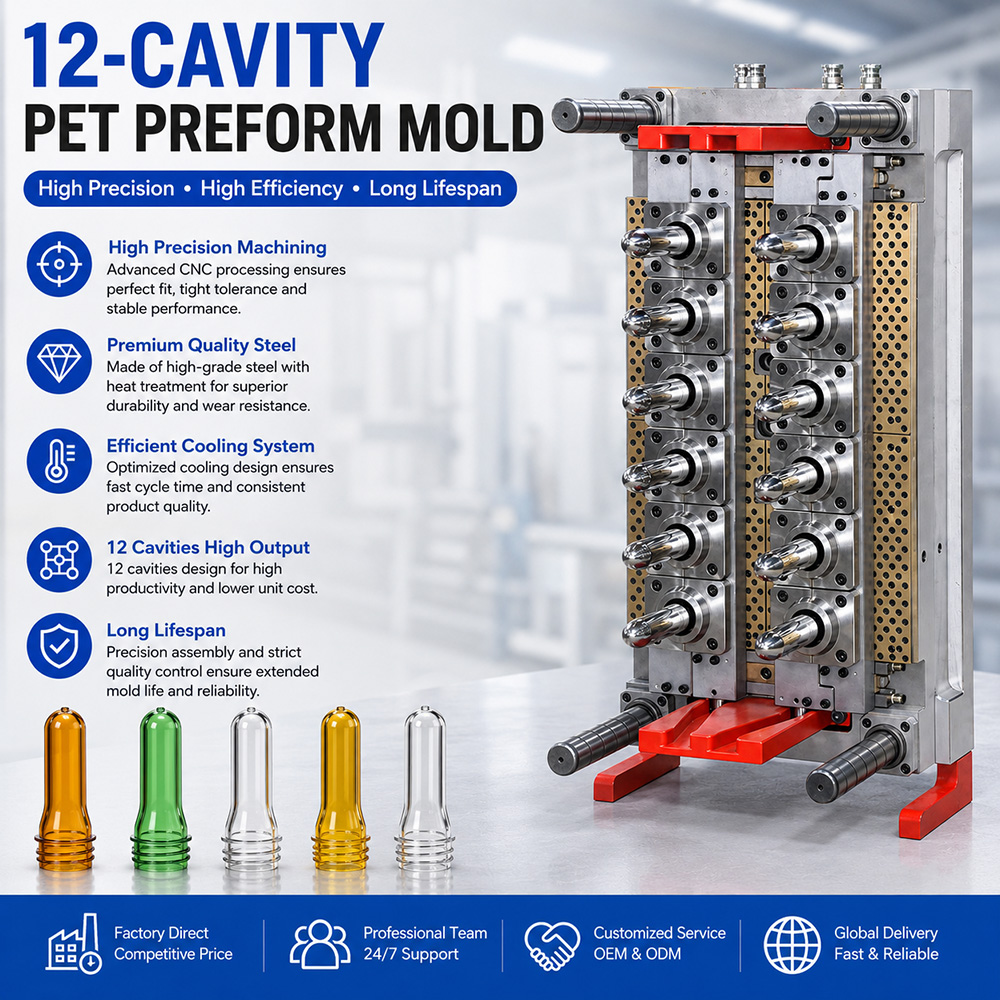
PCO1810 vs PCO1881 Neck Finishes: What Preform Mold Buyers Need to Know
As global beverage packaging standards shift toward sustainability, lightweighting, and higher production efficiency, selecting the right neck finish is a critical decision for preform manufacturers and brand owners. In this technical comparison, ApexMolds—a leading high-precision preform mold manufacturer—breaks down the structural differences, material savings, and tooling considerations between PCO 1810 and PCO 1881 neck finishes to help you optimize your preform mold procurement strategy.
Introduction: The Industry Shift from PCO 1810 to PCO 1881
For decades, the 28mm PCO 1810 neck finish served as the global standard for carbonated soft drinks (CSD) and bottled water. However, as raw material costs skyrocketed and sustainability mandates gained traction, the International Society of Beverage Technologists (ISBT) introduced the PCO 1881 finish. Designed specifically for weight reduction without sacrificing pressure retention, PCO 1881 replaced PCO 1810 across major bottling lines worldwide.
For preform mold buyers, transitioning between these two standards—or managing production for both—requires deep technical insights into mold design, cooling layout, and gate systems.
1. Structural and Dimensional Comparison
The primary advantage of PCO 1881 over PCO 1810 lies in its compact design and reduced height, directly lowering PET material consumption.
| Technical Parameters | PCO 1810 Neck Finish | PCO 1881 Neck Finish |
|---|---|---|
| Neck Finish Height | 21.00 mm | 17.00 mm (4.00 mm shorter) |
| Average Neck Weight | ~5.05 grams | ~3.75 grams |
| Material Savings (per preform) | Baseline | ~1.30 grams saved (~25% reduction) |
| Thread Profile | Continuous thread design | Shortened thread with anti-blowout features |
| Application Focus | Legacy CSD and water bottles | High-speed CSD, sparkling water, and lightweighted packaging |
2. Economic and Environmental Impact for Preform Buyers
For high-volume beverage manufacturers, a 1.30-gram resin reduction per preform translates into massive operational savings:
- Resin Cost Savings: On a production run of 100 million preforms per year, PCO 1881 saves approximately 130 metric tons of PET resin. At current market rates, this delivers annual savings ranging from $130,000 to $180,000.
- Carbon Footprint Reduction: Less raw material utilization directly lowers Scope 3 carbon emissions, aligning your manufacturing plant with ESG compliance standards.
- Shipping Efficiency: Lighter preforms reduce total transport weight, cutting logistics expenses across the supply chain.
3. Preform Mold Engineering & Tooling Considerations
When investing in new preform molds or upgrading existing tooling from PCO 1810 to PCO 1881, mold design precision is paramount. At ApexMolds, our engineering team ensures that every mold core, cavity, and neck ring addresses the following technical challenges:
A. Neck Ring Thermal Control and Cooling Design
Because the PCO 1881 neck finish features thinner walls and a smaller profile, heat dissipation during injection molding must be ultra-uniform. ApexMolds integrates advanced conformal cooling channels into our neck splits, ensuring rapid heat transfer, preventing neck distortion, and maintaining cycle time optimization below industry averages.
B. Dimensional Precision and Ejection Accuracy
PCO 1881 closures demand tighter dimensional tolerances to prevent gas leakage in carbonated drinks. ApexMolds utilizes imported Swiss/Japanese CNC centers and high-grade stainless steel (e.g., S136, 1.2083) to achieve neck ring tolerances within ±0.005mm, guaranteeing perfect seal performance with closure suppliers.
C. Retrolocking and Valve Gate Hot Runner Systems
Transitioning to PCO 1881 often involves high-cavitation molds (32 to 144 cavities). ApexMolds custom builds balanced hot runner systems with individual needle valve gating to ensure minimal gate vestige, low acetaldehyde (AA) levels, and uniform cavity-to-cavity fill rates.
4. Why Partner with ApexMolds for Your Preform Tooling?
As a specialized PET preform mold manufacturing factory, ApexMolds provides end-to-end solutions tailored to global beverage packagers, converter factories, and injection molding plants:
- Turnkey Preform Mold Solutions: High-cavitation preform molds up to 144 cavities compatible with Husky, Netstal, Engel, and KraussMaffei systems.
- Neck Conversion Tooling Kits: Upgrade your existing PCO 1810 molds to PCO 1881 or 26/22 tethered caps with minimal downtime.
- Custom Mold Customization: Tailored core, cavity, and neck ring components designed for fast cycle times and maximum mold lifespan (>5 million cycles).
Conclusion
Choosing between PCO 1810 and PCO 1881 comes down to balancing legacy compatibility with modern lightweighting demands. While PCO 1810 remains present in regional operations, PCO 1881 offers unmatched material cost efficiency and sustainability benefits. Partnering with a dedicated preform mold expert like ApexMolds ensures your injection tooling delivers optimal cooling, minimal cycle times, and long-term reliability.