
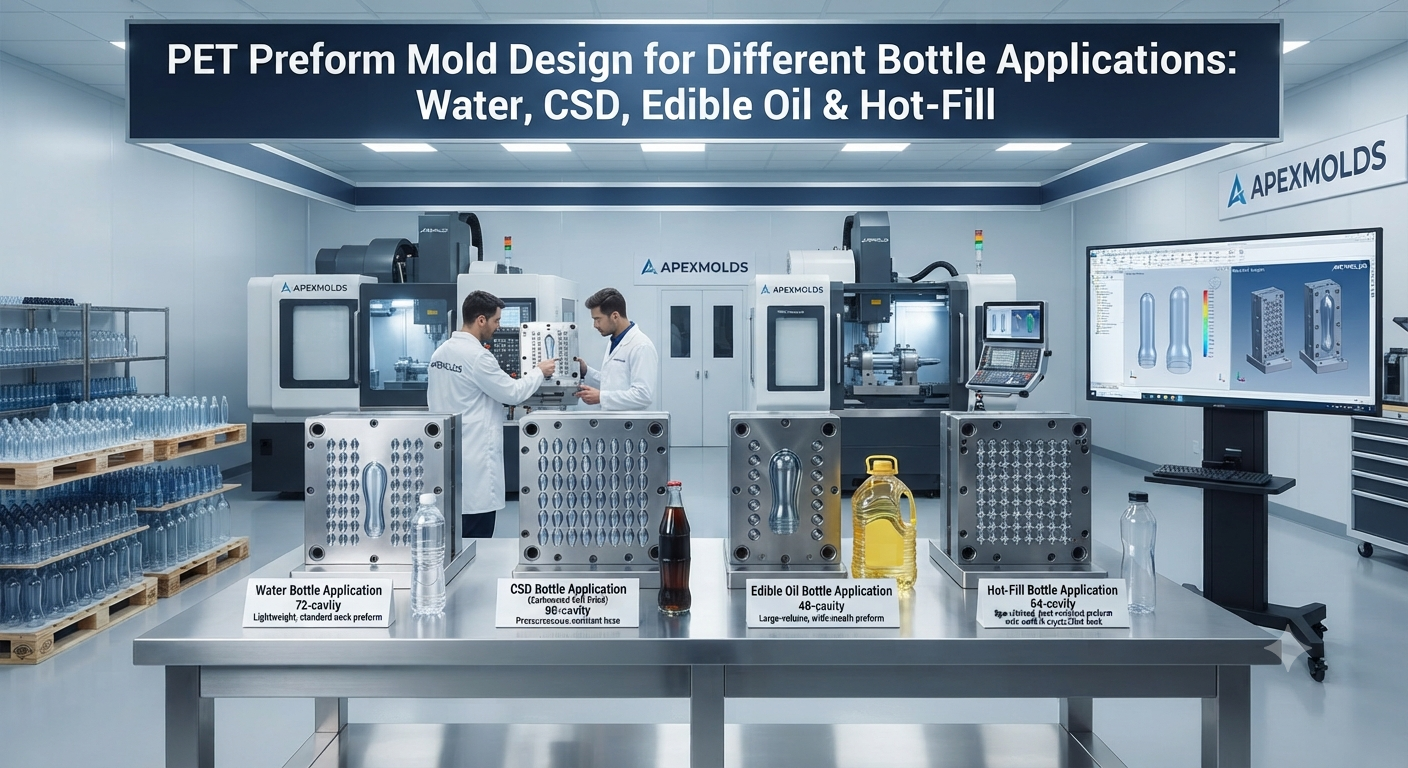
In the global plastic packaging industry, there is no such thing as a "one-size-fits-all" PET preform. A preform engineered to blow a standard lightweight water bottle will instantly fail if subjected to the high internal pressures of a Carbonated Soft Drink (CSD) or the extreme thermal stress of a Hot-Fill juice line. For packaging manufacturers, mastering the structural and thermal nuances of application-specific preform design is crucial to maximizing yield and minimizing material costs.
As a global professional PET preform mold solution expert, Apexmolds breaks down the critical tooling engineering parameters, cooling configurations, and material distribution adjustments required for the four primary packaging applications: Mineral Water, CSD, Edible Oil, and Hot-Fill containers.
1. Mineral Water Bottles: Ultra-Lightweighting & Ultra-Fast Cycles
The primary driver in water preform manufacturing is cost-per-part reduction through aggressive lightweighting. Modern water bottle preforms feature exceptionally thin walls (often between 1.5mm to 2.2mm) and short, short-skirt neck finishes (such as 29/25 or 30/25 blocks).
Apexmolds Tooling Engineering Focus:
- Precision Concentricity: Because the walls are incredibly thin, a core-to-cavity alignment deviation of even 0.05mm will cause a critical thin spot, leading to blow-outs. Apexmolds integrates advanced multi-cone centering alignment systems to ensure perfect wall symmetry.
- Intense Cooling Layout: Thin walls solidify rapidly, but to achieve a cycle time under 10 seconds, the mold must utilize high-velocity cooling water loops in both the cavity inserts and core pins to prevent thermal crystallization at the gate vestige.
2. Carbonated Soft Drinks (CSD): Managing Extreme Carbonation Pressures
CSD containers must withstand internal pressures reaching up to 5 to 6 bars at room temperature. This demands a preform design with significantly thicker walls (usually 3.0mm to 4.5mm) and a robust, heavy neck finish (like PCO 1881 or 1810) with gas-venting slots.
Apexmolds Tooling Engineering Focus:
- Stress-Free Flow Dynamics: Thicker preforms require more material mass injected through the gate. If the gate land or hot runner nozzle tips are poorly designed, high shear stress will induce orientation crystallization, leaving a cloudy ring around the gate. We use comprehensive Moldflow simulations to optimize rheological paths.
- Base Geometry Engineering: The bottom of a CSD preform must be engineered with a precise hemispherical or petaloid-forming contour to allow perfect orientation of the polymer chains during blowing, preventing stress cracking at the center injection point.
3. Edible Oil Containers: Large Necks & Specialized Pouring Lip Geometries
Edible oil preforms are characterized by large neck diameters (ranging from 29mm up to 48mm or more) designed to support snap-on caps, integrated handles, or non-drip pouring inserts. The preform bodies are often tapered or flared to accommodate large-volume handle insertions during blow molding.
Apexmolds Tooling Engineering Focus:
- Large-Pitch Cavity Spacing: Due to the massive neck diameters, standard cavity spacing (pitch) is insufficient. Apexmolds customizes the mold base dimensions and hot runner manifold layouts to ensure optimal mechanical strength between adjacent cavity sets.
- Segmented Slide Actuation: Many edible oil neck designs feature external snap rings or complex undercut locks. We design precision mechanical slide or split-thread mechanics that actuate smoothly without leaving parting-line flash.
4. Hot-Fill Bottles: Crystallized Necks & High-Heat Thermal Stabilization
Hot-fill applications (juices, teas, sports drinks) require the product to be filled at temperatures between 85°C and 92°C. Standard amorphous PET softens at 70°C ($Tg$), causing the bottle neck to warp and leak under vacuum pressure post-cooling. Therefore, hot-fill preforms require localized neck crystallization (whitening) to boost thermal resistance.
Apexmolds Tooling Engineering Focus:
- Integrated Thermal Management: The mold must feature a highly specialized thermal isolation boundary. While the preform body requires extreme chilling to remain clear and amorphous, the neck section often integrates specialized induction or high-temperature oil circuits to intentionally crystallize the neck ring.
- Conformal Post-Cooling: Because the body walls are thick to allow structural panel-blowing, our molds are engineered alongside robotic take-out plates featuring post-cooling pins to actively cool the inside of the preforms post-ejection, preventing post-mold warping.
Application-Specific Engineering Specifications
The following technical reference matrix summarizes the design variations handled by Apexmolds engineers:
| Application | Typical Wall Thickness | Neck Configuration | Primary Tooling Challenge | Apexmolds Engineering Solution |
|---|---|---|---|---|
| Mineral Water | 1.5mm - 2.2mm | Lightweight (e.g., 29/25) | Core deflection & ultra-fast cooling | Double-cone interlocking alignment + high-flow core bubblers |
| CSD | 3.0mm - 4.5mm | Heavy Thread (PCO 1881) | High shear stress & gate crystallization | Balanced hot runner valve-gates + Moldflow flow path balancing |
| Edible Oil | 2.5mm - 3.8mm | Wide Mouth (36mm - 48mm) | Large layout pitch & complex slide locks | Customized heavy-duty mold base + precision mechanical slide elements |
| Hot-Fill | 3.5mm - 5.0mm | Heat-Resistant / Crystallized | Thermal separation & internal cooling | Dual-circuit oil/water zoning + 3D printed conformal cooling inserts |
Partner with Apexmolds: Your Professional PET Preform Solution Experts
Every bottle application dictates a completely unique set of physical, mechanical, and thermodynamic laws. Selecting a supplier that treats all preforms equally leads to high scrap rates, slow cycles, and structural bottle defects. At Apexmolds, our core capability is custom-engineered precision. We analyze your final container performance requirements, resin properties, and machine capabilities to build high-performance hot runner molds that deliver structural excellence and maximum ROI.
Are you developing a new packaging profile for water, CSD, oil, or hot-fill products? Contact our professional technical engineering department today for a complete mold flow analysis and tailored layout configuration simulation.