
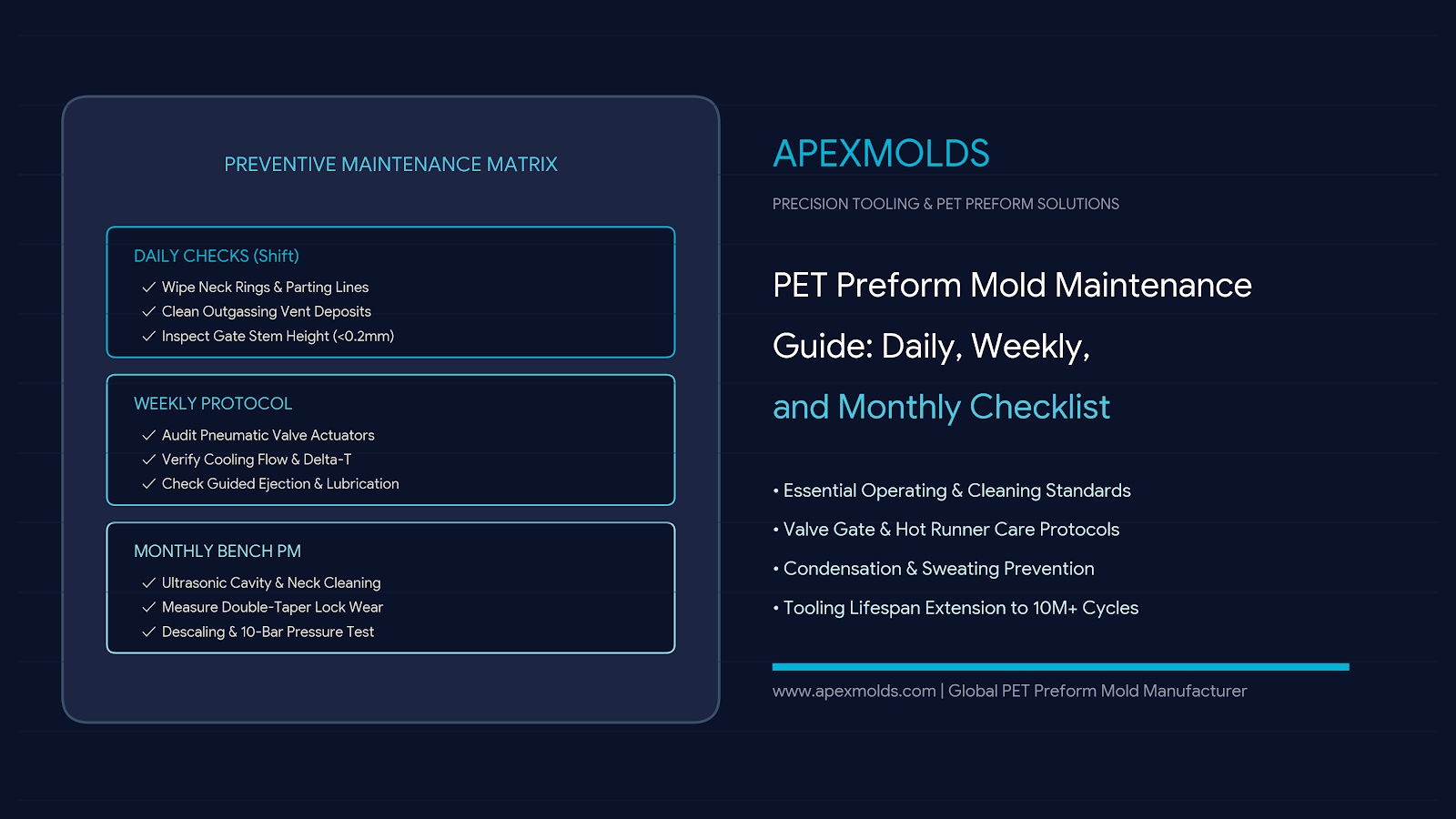
PET Preform Mold Maintenance Guide: Daily, Weekly, and Monthly Checklist
In high-speed PET beverage packaging plants operating 24/7, high-cavity PET preform molds endure relentless thermal cycling, clamp tonnage pressures up to several hundred tons, and extreme injection velocities. Under these demanding conditions, even microscopic PET dust accumulation, water channel scaling, or minor valve pin misalignment can cause unexpected downtime, gate stringing, neck ring flashing, or catastrophic core damage.
Proactive maintenance is the cornerstone of tooling longevity and consistent part quality. A well-executed Preventive Maintenance (PM) program extends mold service life beyond 10 million cycles while safeguarding preform weight consistency, optical clarity, and low Acetaldehyde (AA) levels. As a global PET preform mold manufacturer and turnkey solutions expert, Apexmolds presents a systematic, industry-tested maintenance framework designed for mold technicians, maintenance supervisors, and plant managers.
Core Engineering Insight: Unscheduled mold maintenance costs up to five times more than structured preventive maintenance. Establishing a disciplined daily, weekly, and monthly maintenance schedule preserves mold alignment tolerances (≤0.005mm), reduces scrap rates below 0.3%, and prevents premature component fatigue.
1. Why PET Preform Molds Require Specialized Maintenance Standards
Unlike standard commodity injection molds, PET preform tooling operates under distinct physical and mechanical stresses that demand dedicated maintenance protocols:
- Chilled Mold Operation & Condensation (Sweating): Molds operate with cooling water temperatures between 6°C and 12°C. High ambient humidity leads to moisture condensation on mold faces, accelerating surface rust if proper shutdown purge procedures are neglected.
- PET Dust & Outgassing Residue: High-pressure injection produces fine PET dust and gas deposits that coat neck ring splits and venting grooves. If uncleaned, this buildup prevents full mold closure, causing parting line flash and damaged parting faces.
- Pneumatic Valve Gate Precision: Individual valve pins actuate millions of times per month within tight clearances (<0.02mm). Sticky resin degradation or pneumatic seal wear directly causes stringing, gate leakage, or stuck valve stems.
2. Comprehensive Maintenance Checklist Framework
A. Daily Maintenance Checklist (Every Shift / 24 Hours)
Daily checks focus on non-destructive cleaning, surface inspection, and monitoring operational parameters while the mold is installed on the injection molding machine.
- Neck Ring & Cavity Face Wipedown: Wipe down neck split faces and cavity parting lines using a lint-free microfiber cloth and approved copper-safe cleaner to remove PET dust and condensation.
- Vent Cleanliness Check: Inspect parting line gas vents for PET outgassing buildup. Clean gently using non-abrasive brass scrapers or solvent wipes.
- Hot Runner & Gate Stem Visual Inspection: Check preform samples for gate stem height (≤0.2mm), stringing, or black specs. Inspect valve pin movement for smooth actuation.
- Cooling Water Leakage Audit: Verify zero water seepage around core lock plates, cavity bases, and manifold hose connections.
- Automatic Lubrication Verification: Inspect central lube points on slide guides, taper interlocks, and ejector plates to ensure smooth movement without over-greasing into cavity zones.
- Condensation Dry-Purge Procedure: Prior to any machine stoppage exceeding 10 minutes, turn off chilled water and enable mould air blowers to prevent mold sweating.
B. Weekly Maintenance Checklist (Every 150,000–200,000 Cycles)
Weekly protocols involve detailed functional checks and minor maintenance performed during scheduled production pauses.
- Pneumatic Valve Gate System Audit: Test individual air lines feeding cylinder actuation plates. Check for air leaks and clean pneumatic solenoid valve exhaust filters.
- Guided Ejection & Slide Alignment Check: Inspect wear plates, guide pillars, and alignment bushings for wear or scoring. Apply food-grade synthetic grease sparingly.
- Water Flow & Delta-T Measurement: Measure cooling water flow rates and inlet/outlet temperature differential (ΔT should remain ≤2°C). Flush circuit lines if temperature drift indicates clogging.
- Hot Runner Electrical Terminal Inspection: Inspect thermocouple connectors, heater cables, and wiring junction boxes for oxidation, loose screws, or heat degradation.
- Target Cavity Sample Audit: Collect full-shot preform samples from all cavities. Conduct weight variance (±0.1g limit) and dimensional concentricity checks to identify early core drift.
C. Monthly Maintenance Checklist (Every 800,000–1,000,000 Cycles / Off-Machine Bench PM)
Monthly preventive maintenance requires removing the mold from the machine for bench-top disassembly, ultrasonic cleaning, and precision measurement.
- Ultrasonic Cleaning of Cavity & Neck Inserts: Disassemble neck ring splits and cavity inserts. Perform ultrasonic bath cleaning to remove stubborn PET deposits without altering micro-geometry.
- Core & Taper Wear Inspection: Inspect core rod double-tapers and cavity locking angles using optical comparators or micrometer gauges to verify lock-up tolerances.
- Valve Pin Replacement & Re-alignment: Remove valve pins, check for tip erosion, bending, or carbon buildup. Replace worn valve stem packing seals and O-rings.
- Water Channel Descaling & Pressure Testing: Flush internal cooling channels with anti-scaling descaling solution. Perform 10-bar hydrostatic pressure testing to verify seal integrity.
- Hot Runner Heaters & Thermocouples Resistance Test: Check electrical resistance (Ohms) across all hot runner heater bands and nozzles to replace aging elements before failure.
- Corrosion Protection & Long-Term Storage Prep: If placing tooling in storage, apply a high-grade rust inhibitor spray across all polished cavity surfaces, install mold locking straps, and drain internal water circuits completely using compressed air.
3. Maintenance Quick-Reference Matrix
| Frequency | Key Maintenance Area | Action Required | Tool / Material Used | Operational Objective |
|---|---|---|---|---|
| Daily | Neck Rings & Parting Lines | Wipe PET dust & condensate buildup | Microfiber cloth + copper solvent | Prevent parting line flash & damage |
| Daily | Hot Runner Gate Tips | Visual check for vestige/stringing | Optical magnifier / sample gauge | Maintain gate quality & prevent jams |
| Weekly | Pneumatic Actuators | Leak check air lines & solenoids | Pressure gauge / soap spray | Ensure clean valve pin shut-off |
| Weekly | Cooling Circuit Flow | Monitor flow rates & ΔT differential | Digital flowmeter / thermal sensors | Preserve optimal cycle times |
| Monthly | Cavity Inserts & Neck Splits | Ultrasonic deep cleaning & inspection | Ultrasonic bath + citrus cleaner | Remove stubborn outgassing film |
| Monthly | Core & Lock Alignment | Measure double-taper wear profiles | Micrometer / CMM inspection | Maintain wall concentricity ≤0.04mm |
4. Apexmolds Design Features for Simplified Maintenance
At Apexmolds, we engineer our PET preform tooling with maintenance efficiency built directly into the design:
- Quick-Change Cavity & Core Inserts: Modular tooling architecture allows technicians to replace individual cores, cavities, or neck rings directly on the injection machine without dismounting the complete mold base.
- Premium Swiss S136 Hardened Stainless Steel: Cavity components treated to HRC 48–52 deliver superior resistance against abrasive PET resins, outgassing corrosion, and mechanical wear.
- Self-Centering Lock-Up Geometry: Double-taper alignment reduces friction wear during mold opening and closing, simplifying bench assembly re-alignment.
- Standardized Interchangeable Components: Valve pins, nozzles, seals, and heater elements are fully standardized across Apexmolds platforms for immediate off-the-shelf replacement.
Optimize Your Mold Maintenance Protocol with Apexmolds
Need customized maintenance training for your plant technicians, specialized spare parts kits, or high-performance PET preform molds designed for maximum uptime? Contact the Apexmolds technical team today.