
PET Preform Mold vs PET Blow Mold: What’s the Difference and Why It Matters
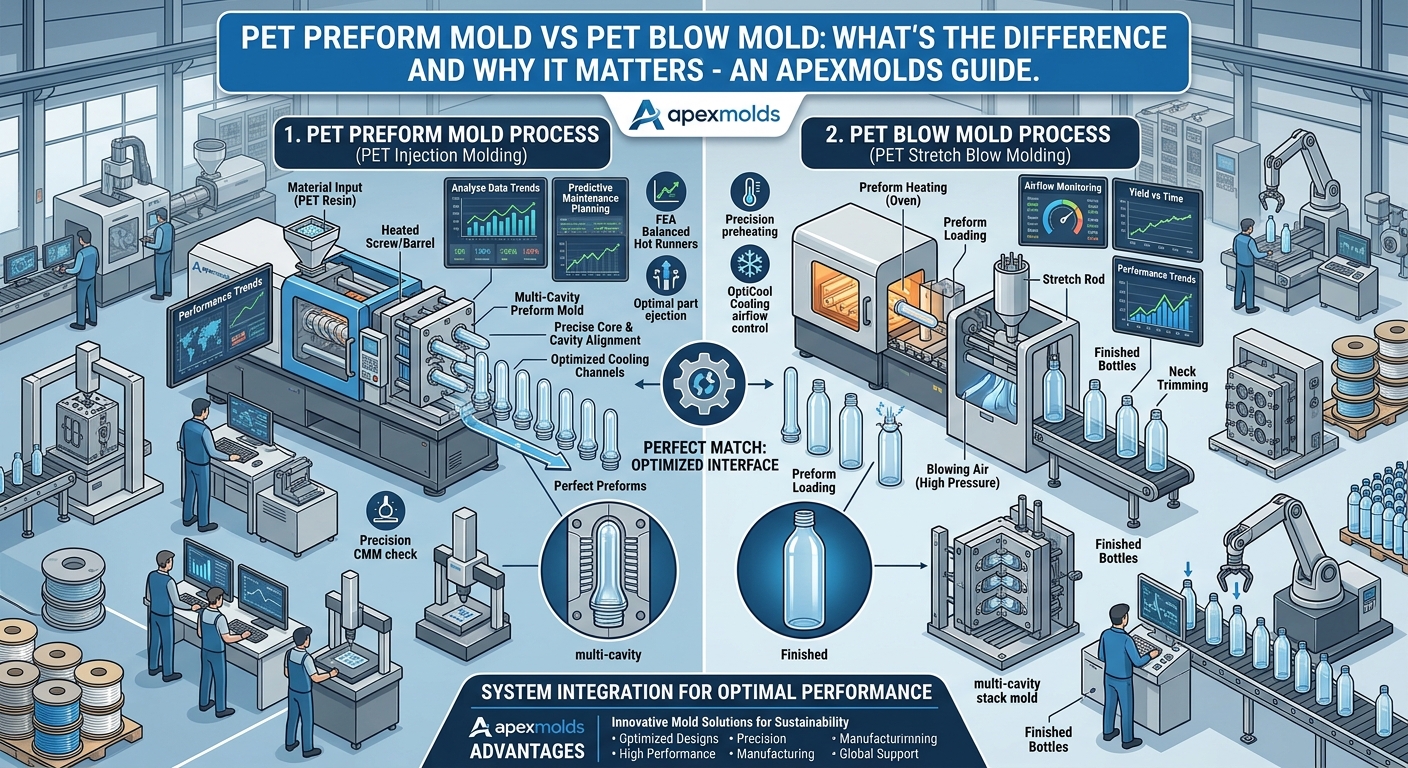
In the PET packaging industry, converting virgin Polyethylene Terephthalate (PET) resin into a finished beverage or edible oil container involves a two-stage manufacturing process. First, resin granules are melted and injected to create a thick-walled test-tube-like component known as a preform. Second, that preform is reheated and stretched using compressed air into its final bottle shape. Because both steps involve specialized tooling, plant managers and procurement teams often conflate the roles of PET Preform Molds and PET Blow Molds.
While both tooling types are critical to bottle production, they operate under fundamentally different thermodynamic principles, mechanical pressures, tolerance requirements, and steel alloy specifications. As a specialized global PET preform mold manufacturer and engineering solutions provider, Apexmolds breaks down the core technical distinctions between preform molds and blow molds—and why understanding these differences is essential to optimizing plant CAPEX and production efficiency.
Core Engineering Rule: The preform mold dictates material distribution, wall thickness uniformity, weight precision, and neck thread geometry. The blow mold determines final container aesthetics, structural rib strength, label area contour, and base stability. Flaws in the preform mold cannot be corrected by the blow mold.
1. Process & Thermodynamic Fundamental Differences
The primary distinction between preform molds and blow molds lies in the phase of the PET material during processing:
- PET Preform Mold (Injection Phase): Processes molten PET at temperatures between 270°C and 300°C under extreme hydraulic injection pressures ($600 - 900\text{ bar}$). The mold must rapidly freeze the amorphous molten polymer using intensive chilling channels ($6^\circ\text{C} - 10^\circ\text{C}$) to prevent premature crystallization, ensuring optical clarity and low Acetaldehyde (AA) levels.
- PET Blow Mold (Stretch Blow Molding Phase): Processes solid preforms that have been reheated above PET’s glass transition temperature ($90^\circ\text{C} - 115^\circ\text{C}$). High-pressure compressed air ($30 - 40\text{ bar}$) stretches the soft plastic outward against the cavity walls. Because the material is not in a molten state, operating temperatures and internal pressures are dramatically lower than in injection molding.
2. Technical Comparison Matrix: Preform Mold vs. Blow Mold
| Engineering Parameter | PET Preform Mold (Apexmolds Focus) | PET Blow Mold |
|---|---|---|
| Manufacturing Process | High-Pressure Plastic Injection Molding | Stretch Blow Molding (SBM) |
| Operating Pressure | 600 to 900+ bar (Melt Injection Pressure) | 30 to 40 bar (High-Pressure Blowing Air) |
| Tooling Steel / Alloy | Premium Stainless Steel (Swiss S136, HRC 48–52) | Aircraft-Grade Aluminum (7075-T6) or Stainless Steel |
| Dimensional Tolerance | Micron-level precision (≤0.005mm) | Standard machining tolerance (±0.05mm) |
| Hot Runner System | Integrated Valve-Gate Hot Runner Manifold | None (Cold mechanical operation) |
| Tooling Complexity | Very High (Core, Cavity, Neck Splits, Hot Runner) | Moderate (Shell cavity halves + Base Mold) |
| Cooling Requirements | Chilled water circuits with high flow rates | Ambient or low-pressure chilled water lines |
| Design Flexibility | Fixed neck standards; versatile for multiple bottle shapes | Dedicated to a specific bottle shape and label design |
3. Key Structural Components & Metallurgical Demands
A. PET Preform Mold Engineering Standards
Because preform molds experience relentless cyclic fatigue, micro-vibrations, and contact with hot melt outgassing, steel quality and core-to-cavity concentricity are paramount:
- Core Rods & Cavity Inserts: Precision-machined from corrosion-resistant Swiss S136 stainless steel hardened to HRC 48–52. Cores require self-centering double-taper locking alignment to maintain wall thickness eccentricity below 0.04mm.
- Neck Ring Split Assemblies: Feature diamond-cut thread profiles to form perfect seal surfaces (e.g., PCO 1881, 26/22, 38mm). Hardened surfaces resist wear from continuous slide ejection.
- Valve Gate Hot Runner Manifold: Incorporates individual pneumatic actuators, balance-tuned melt channels, and titanium thermal isolation nozzles to ensure identical weight distribution across all drops.
B. PET Blow Mold Construction Standards
Blow molds prioritize rapid heat dissipation and lightweight construction over extreme pressure resistance:
- Aluminum Cavity Shells: Often crafted from high-strength 7075-T6 aluminum to reduce weight and enable rapid mold changes on rotary blow molding machines.
- Base Mold (Petaloid Mold): Dedicated bottom-forming section engineered to shape five-star petaloid bases for carbonated soft drinks (CSD) or flat bases for still water.
- Venting Systems: Micro-perforated air vents allow trapped air between the preform wall and cavity surface to escape instantly during high-speed blowing.
4. Why Preform Mold Precision Dictates Bottle Quality
A common mistake in packaging line setup is attributing final bottle defects to the blow mold when the root cause resides in the preform mold:
- Uneven Bottle Wall Thickness: If a preform mold core has a eccentricity error of just 0.08mm, one side of the preform wall will be thinner. When stretched in the blow mold, the thin side stretches faster, creating weak spots, bottle bursting, or top-load failure.
- Neck Deformation & Leakage: Thread sealing surfaces are fully formed in the preform injection mold. A poor preform neck split design results in cap leakage regardless of how perfect the blow mold is.
- Gate Stress & Haze: High Acetaldehyde (AA) or crystallite haze generated in a poorly cooled preform gate area leads to brittle bottle bases after blowing.
5. Why Partner with Apexmolds for Your Preform Tooling
At Apexmolds, we focus exclusively on high-cavity, high-precision PET preform tooling solutions engineered for long service lives (exceeding 10 million cycles):
- Turnkey Preform Design Optimization: We analyze your target bottle geometry and stretch ratios to design custom preform weight, length, and wall taper profiles.
- Interchangeable Modular Architecture: Our preform molds feature quick-change neck splits and cavity stacks, allowing you to adapt to new thread finishes without purchasing complete new mold bases.
- Universal Machine Integration: Apexmolds preform tooling packages are engineered to interface seamlessly with leading global injection molding platforms including Husky, Netstal, KraussMaffei, Engel, Haitian, and Yizumi.
Upgrade Your PET Preform Tooling Performance
Looking to improve preform weight consistency, shorten cycle times, or engineer preforms for new bottle lightweighting projects? Contact the technical specialists at Apexmolds today.