
Why Mold Cooling Design Matters More Than Steel Type in Preform Quality
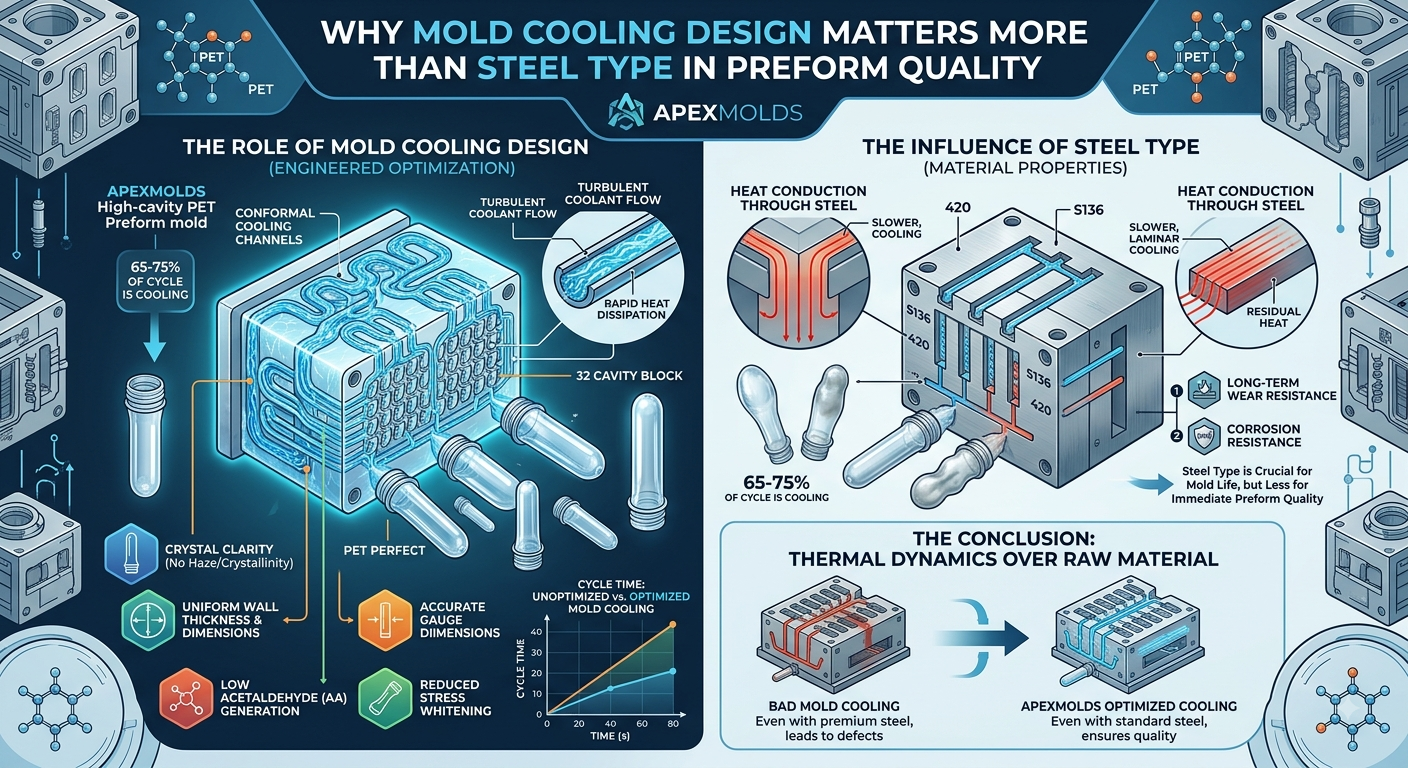
In the PET preform tooling industry, purchasing discussions frequently focus on steel grades. Buyers ask whether cavities and cores are made of Swiss S136, 420 stainless steel, or hardened tool steels. While selecting high-grade steel is essential for long-term wear resistance and corrosion defense, focusing solely on steel selection overlooks the most influential factor in preform quality and line efficiency: mold cooling circuit design.
In high-speed PET injection molding, cooling accounts for 65% to 75% of the total cycle time. More importantly, polymer physics dictates that PET optical clarity, crystalline behavior, thermal shrinkage, and wall thickness uniformity are directly controlled by rapid, uniform heat extraction. As an industry-leading PET preform mold manufacturer and engineering specialist, Apexmolds explains why cooling architecture surpasses steel type in determining overall preform performance.
Core Technical Takeaway: Even the highest grade of S136 stainless steel cannot compensate for poorly placed cooling lines or laminar coolant flow. A mold constructed with premium steel but suboptimal cooling channels will produce cloudy preforms with residual thermal stress and extended cycle times. Precision thermal engineering is what translates premium raw steel into high-yield tooling.
1. Polymer Physics: How Cooling Governs PET Quality
Polyethylene Terephthalate (PET) is a semi-crystalline polymer. To achieve pristine, crystal-clear preforms suitable for stretch blow molding (SBM), the molten PET resin (injected at temperatures between 270°C and 290°C) must be rapidly quenched below its glass transition temperature (Tg ~78°C) before polymer chains organize into crystalline structures.
- Thermal Crystallization (Cloudiness/Haze): If heat extraction is too slow or inconsistent across cavity walls, the PET resin crystallizes, creating a milky, cloudy appearance that compromises bottle strength and clarity.
- Differential Shrinkage & Eccentricity: Uneven cooling between core and cavity or along the preform axis causes asymmetric thermal contraction. This leads to core drift, wall thickness variations (eccentricity >0.08mm), and uneven stretching during blow molding.
- Neck Finish & Gate Residual Stress: Slow heat dissipation at thick areas like the neck ring finish or gate area leads to thread deformation, gate stringing, or high Acetaldehyde (AA) levels.
2. Steel Thermal Conductivity vs. Circuit Fluid Dynamics
A common misconception in mold procurement is that switching steel grades automatically solves thermal bottlenecks. Comparing the thermal physics of tool steel against water flow dynamics reveals why cooling channel geometry dominates the thermal equation:
| Engineering Parameter | Standard Tool Steel (e.g., S136 / P20) | Advanced Heat Transfer Inserts (e.g., BeCu) | Apexmolds Conformal Cooling Design |
|---|---|---|---|
| Thermal Conductivity | ~18 – 24 W/(m·K) | ~100 – 130 W/(m·K) | Optimized Fluid Dynamic Heat Removal |
| Impact on Heat Flow | Conducts heat through bulk metal (Passive) | Accelerates localized heat conduction (Active) | Removes heat directly via turbulent fluid flow (Dynamic) |
| Primary Function | Structural integrity, polish, anti-corrosion | Eliminates localized hot spots (e.g., core tip) | Drives rapid cooling phase & cycle time reduction |
While high-hardness steel provides a durable cavity surface, its thermal conductivity is inherently low (~20 W/m·K). Without engineered internal water channels located closely and uniformly around the preform profile, heat accumulates in the steel, creating thermal bottlenecks regardless of steel hardness or grade.
3. Key Elements of Apexmolds High-Performance Cooling Engineering
1) 3D Conformal & Spiral Cooling Channels
Standard molds utilize straight-drilled cooling channels due to lower machining costs. However, straight channels leave large steel masses uncooled near curved neck ring transitions and core tips. Apexmolds incorporates 3D conformal cooling channels in cavity inserts and spiral cooling baffles inside core rods. This design follows the exact contour of the preform wall, ensuring equal distance between coolant and molten resin.
2) Turbulence Flow Management (Reynolds Number Optimization)
Coolant flow velocity is as critical as channel location. Laminar water flow creates an insulating boundary layer against channel walls, drastically reducing heat transfer. Apexmolds engineers mold cooling circuits to maintain turbulent flow with high Reynolds numbers (Re > 4,000), maximizing forced convection heat exchange.
3) Beryllium-Copper (BeCu) Core Tip Integration
The injection gate zone and slender core tip experience extreme thermal energy during each shot. Apexmolds strategically embeds high-thermal-conductivity Beryllium-Copper alloy inserts into core tips and gate areas, accelerating heat transfer into deep internal water channels and keeping cycle times fast without thermal degradation.
4) Independent Neck Ring Split Cooling
The neck finish contains thick thread profiles that retain heat longer than the thin preform body. Apexmolds features dedicated, direct-chilled cooling loops within neck ring splits. This prevents thread warping during rapid ejection, protecting seal dimensions and capping torque integrity.
4. The Commercial Impact: Cycle Time & Yield Analysis
The practical difference between a steel-focused mold with standard cooling and an Apexmolds thermomechanical solution is reflected directly on the production floor:
| Performance Metric | Standard Mold (Focus on Steel Only) | Apexmolds Engineered Cooling System |
|---|---|---|
| Cycle Time (24g Water Preform) | 12.5 – 14.0 seconds | 9.5 – 10.8 seconds |
| Preform Optical Haze / Clarity | Inconsistent (Risk of gate haze) | 100% Crystal Clear (Low Haze) |
| Preform Wall Eccentricity | ≤ 0.08 mm | ≤ 0.04 mm |
| Annual Yield Gain (32-Cavity) | Baseline Output | + 4.5 Million Units / Year |
5. Why Partner with Apexmolds for Turnkey PET Tooling?
At Apexmolds, superior steel quality (using certified Swiss S136 stainless steel) is taken for granted as our foundational baseline. What sets our tooling apart is our advanced thermal engineering capability. Every Apexmolds preform mold undergoes Mold Flow Thermal Analysis (MFA) and Computational Fluid Dynamics (CFD) to optimize water flow distribution, eliminate thermal hot spots, and guarantee optimal cooling balance across all cavities.
Whether you manufacture light-weighted water preforms, CSD preforms, wide-mouth food jars, or specialty hot-fill containers, Apexmolds delivers high-cavity preform molds (8 to 144 cavities) that maximize production yield, reduce unit energy consumption, and lower your cost-per-preform.
Ready to Optimize Your PET Preform Cycle Time & Quality?
Contact Apexmolds thermal engineering specialists today to review your preform cooling design, request mold flow analysis, or obtain a custom quotation.