
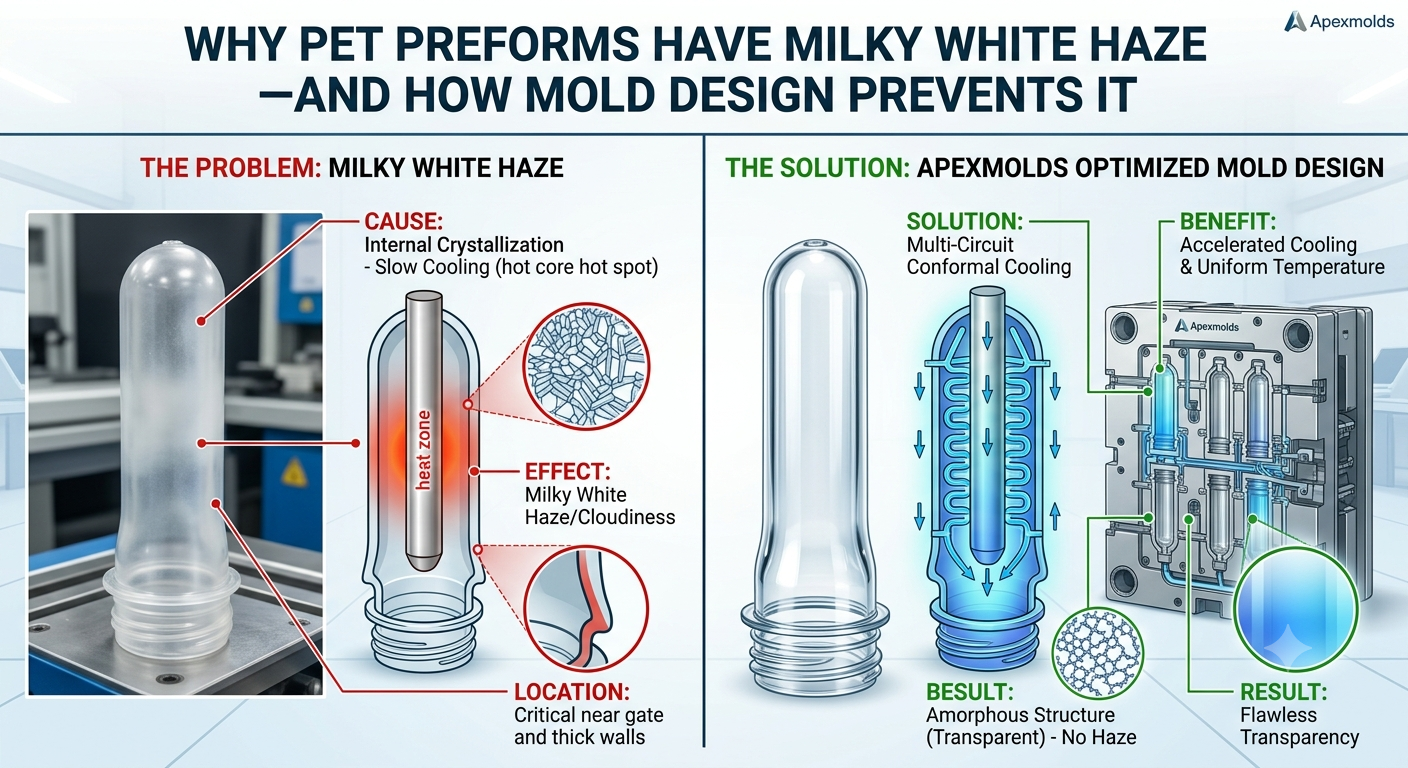
Why PET Preforms Have Milky White Haze—and How Mold Design Prevents It
In the PET injection molding industry, achieving flawless optical clarity is the hallmark of premium production. However, manufacturers frequently encounter a critical quality defect: a cloudy, opaque imperfection known as **milky white haze**. This visual defect is not just an aesthetic issue; it signifies a structural weakness that can lead to catastrophic failures during the stretch-blow molding phase.
While many injection molding technicians immediately attempt to resolve this by tweaking process parameters like barrel temperature or cycle times, the root cause often lies deeper within the tooling architecture itself. As a global professional PET preform mold solution expert, Apexmolds delivers a comprehensive technical analysis of why milky white haze occurs and how advanced mold design permanently prevents it.
1. The Science Behind the Scourge: What Causes Milky White Haze?
PET (Polyethylene Terephthalate) is a semi-crystalline polymer. In its raw resin state, it can exist in two morphological phases: amorphous (transparent, disordered molecular chains) and crystalline (opaque, highly ordered molecular structures).
To produce a perfectly clear preform, the molten PET must be cooled so rapidly that the polymer chains are "frozen" in their disordered, amorphous state before they have time to form organized crystals. If the cooling rate drops below a critical threshold within the crystallization temperature window—typically between 120°C and 180°C—the molecules arrange themselves into crystalline structures called spherulites. These spherulites scatter light, creating the dreaded **milky white haze**.
The Two Types of Preform Haze:
- Thermal Haze (Over-Crystallization): Occurs when the cooling rate is too slow, giving the molecules ample time to crystallize. This is most common in thick-walled preforms or near the heavy mass of the injection gate.
- Stress Haze (Mechanical Crystallization): Occurs when the PET melt experiences excessive shear stress during the filling stage, forcing the polymer chains to align and crystallize prematurely, even if the cooling system is functional.
2. How Advanced Mold Design Eliminates Haze
Alleviating white haze purely through machine adjustments often forces operators to extend cycle times, destroying plant productivity. The true, sustainable remedy is an optimized mold design. At Apexmolds, we combat crystallization through three sophisticated engineering approaches:
A. Conformal Cooling Inserts & High-Conductivity Alloys
Standard cooling channels drilled via traditional CNC machining cannot get close enough to complex geometries like the preform gate area or the neck ring. This leaves localized thermal hotspots where white haze thrives.
Apexmolds solves this by integrating **3D-printed conformal cooling channels** within the cavity inserts, allowing the coolant to wrap uniformly around the entire profile of the preform. Furthermore, we manufacture the gate area and neck ring using specialized **beryllium-free copper alloys** possessing a thermal conductivity up to 4 times higher than standard tool steel. This triggers an ultra-rapid thermal quench, instantly freezing the PET in its amorphous, transparent state.
B. Optimized Hot Runner Gate Geometries
If the valve gate diameter is too narrow, the molten PET is subjected to immense shear stress as it is forced into the cavity. This high shear rate induces orientation crystallization, leading to stress haze around the gate.
Our engineering team utilizes advanced **Moldflow simulation software** to meticulously calculate the optimal gate diameter and land length for your target preform weight. By streamlining the rheological flow paths and balancing pressure drops within the hot runner manifold, we minimize shear stress and eliminate gate haze entirely.
C. Dual-Circuit Core and Cavity Cooling
The core pin (the inner part of the mold) absorbs a massive amount of heat because it is trapped inside the molten preform. If the inner core cooling is insufficient, the interior wall of the preform will cool slower than the exterior wall, causing an internal layer of milky haze. Apexmolds implements **independent dual-circuit cooling systems** featuring premium baffles or bubblers inside the core pins, ensuring identical cooling rates on both the internal and external surfaces of the preform.
3. Tooling Matrix: Defect vs. Mold Solution
To assist packaging plants in structural diagnostics, the Apexmolds technical department has compiled this engineering reference matrix:
| Haze Location & Symptom | Root Technical Cause | Apexmolds Tooling Solution |
|---|---|---|
| Haze localized exactly at the gate tip | Slow heat dissipation post-injection / High shear stress | Copper alloy gate inserts + Optimized valve-gate pin geometry |
| Haze forming an internal ring inside the body | Core pin thermal saturation; coolant flow bypasses the tip | High-flow core bubbler systems with precise internal depth tracking |
| Haze in exceptionally thick-walled sections | Insufficient cooling penetration through the plastic mass | Conformal cooling channel layout + Optimized cooling water flow rate (≥ 15 L/min) |
| Streaks of haze along the preform body | Unbalanced hot runner manifold causing uneven melt temperature | Naturally balanced hot runner flow channels with precise PID zone control |
Partner with Apexmolds: Your Professional PET Preform Solution Experts
Eliminating milky white haze requires more than just high clamping force; it demands absolute mastery over thermodynamics and fluid mechanics. A mold engineered by Apexmolds doesn't just eliminate aesthetic defects—it yields preforms with superior tensile strength, pristine clarity, and perfect material distribution, translating directly to fewer blow-outs on your blowing lines and a healthier bottom line.
Don't let scrap rates erode your margins. Contact the Apexmolds engineering department today for a professional mold design audit and custom-engineered cooling simulations tailored to your production demands.